Risks of Selling Covered Calls: What Can Go Wrong?
Key takeaway
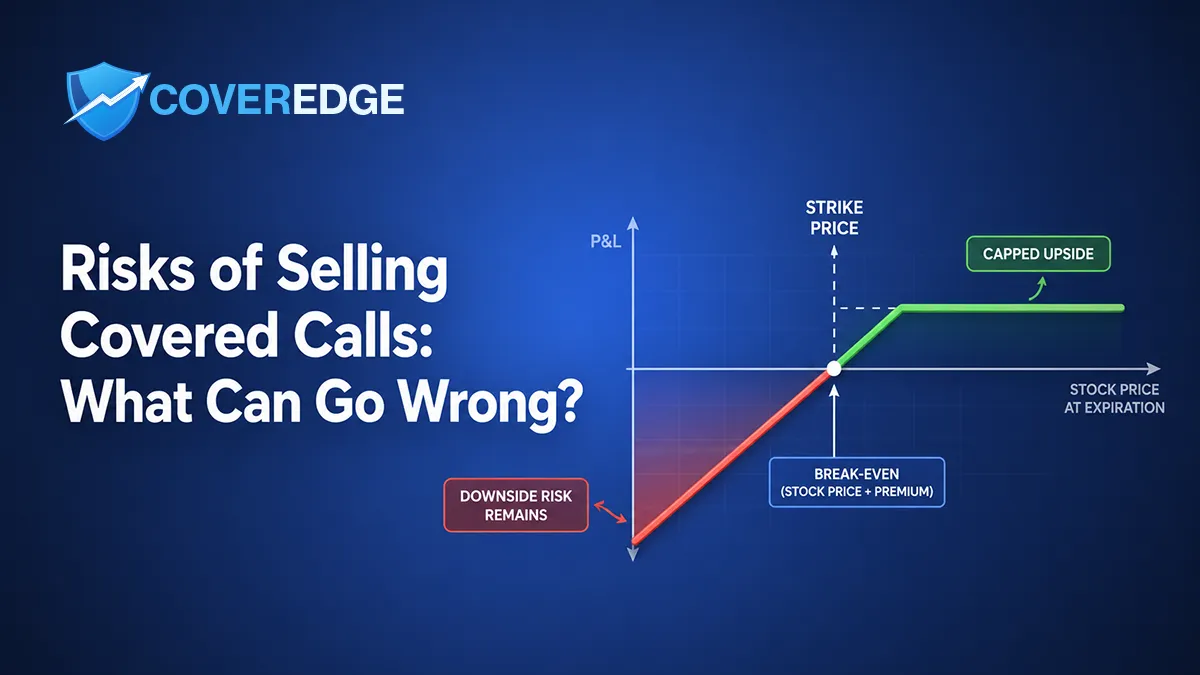
The main risk of selling covered calls is not the option — it is the stock. You still own 100 shares, so a decline is your loss, cushioned only slightly by the premium. The other risks are capped upside when the stock rallies past the strike, assignment that forces a sale below your cost basis, early assignment around ex-dividend dates, rolling that quietly compounds a loss, wide bid/ask spreads on illiquid options, and holding-period and wash-sale tax surprises. None of these make covered calls a bad strategy; they just mean the income is real but never free of risk. Manage it by writing calls only on shares you are happy to hold and to sell, keeping strikes at or above your basis, checking the event calendar, favoring liquid contracts, and sizing for the downside rather than the yield.
Track your covered call & cash-secured put income with ledger-grade P&L in CoverEdge — free 14-day Pro trial, no card.
Start free trialSelling covered calls is often called a conservative, income-generating strategy, and compared with most options trades it is. But “lower risk” is not “no risk.” A covered call does not reduce the money you can lose on the stock — it collects a premium in exchange for capping your upside, and that trade-off has several sharp edges. The biggest danger is simple to state and easy to forget: you still own the shares, so the largest risk in the position is the stock falling, not the option.
This guide is educational, not investment advice or a recommendation to sell or avoid covered calls. Every number below is illustrative. Your cost basis, taxes, fees, dividends, and willingness to hold or sell the shares all change the picture.
Try the math on a real ticker — for free
Plug in any of 200+ tickers and get live premium, annualized yield, breakeven, and assignment P&L instantly. No signup, no credit card.
First, the Payoff You Are Actually Agreeing To
A covered call combines two positions: 100 shares you own and one call you sell against them. The premium is yours to keep no matter what happens. In exchange, you agree to sell the shares at the strike price if the buyer exercises. That produces a lopsided payoff — a capped gain above the strike and a nearly full loss if the stock falls. If you are new to the mechanics, start with what a covered call is and come back; the risks below all follow from that shape. To see the shape itself — the capped upside and the sloping downside tail on one curve — read how to read a covered call graph.
- Your maximum gain is fixed the moment you sell the call: the premium plus any appreciation from your basis up to the strike.
- Your downside is almost the entire stock position, softened only by the premium you collected.
- The premium is compensation for giving up the upside, not a discount that makes the shares safer to own.
The Seven Real Risks of Selling Covered Calls
1. Downside Risk on the Stock (the Big One)
You still own 100 shares, so if the stock drops, you take the loss. A $2.00 premium on a $60 stock cushions the first 3.3% of the decline and nothing more. If the shares fall to $48, the $200 premium does not meaningfully offset a $1,200 unrealized loss. Selling calls on a stock you would not otherwise want to hold is the most expensive mistake in the strategy, because the premium tempts you into owning something you do not believe in.
2. Capped Upside and Opportunity Cost
The flip side of collecting premium is surrendering the rally. If you sell a $65 call and the stock jumps to $80 on news, your shares are called away at $65. You keep the premium and the gain up to the strike, but you miss the entire move above it. Over a long bull run, a steady diet of covered calls on your best performers can quietly cost far more than the premium ever paid you. The shares are also “spoken for” while the call is open, so you cannot cleanly sell them without buying the call back first.
3. Assignment Below Your Cost Basis
A call can be assigned any time it is in the money, and assignment forces you to sell at the strike. If you sold a strike below what you paid for the shares, you lock in a loss on the stock even though the option “worked.” This is why strike selection matters so much: the premium on a below-basis strike can look attractive and still guarantee a bad outcome. Our guide to picking a covered call strike walks through anchoring on delta and basis instead of raw premium, and the assignment guide covers what happens step by step when the shares are called away.
4. Early Assignment Around Dividends
American-style equity options can be exercised early, and the classic trigger is an ex-dividend date. When a call is in the money and the remaining time value is smaller than the upcoming dividend, the buyer may exercise early to capture the payout — taking your shares the day before the ex-date and, with them, the dividend you expected. Selling near-the-money or in-the-money calls into an ex-dividend date raises this risk sharply. Knowing your holding's dividend calendar is part of managing the position.
5. Rolling That Turns a Small Loss Into a Bigger One
When a call goes against you, rolling — buying it back and selling a later or higher-strike call — can buy time or lift the ceiling. But rolling is not free, and rolling to avoid ever booking a loss is a habit that hides damage. Paying a net debit to chase a falling or surging stock can cost more than simply accepting assignment or closing. The honest number is the cumulative profit and loss of the whole roll chain, not the credit on any single roll. If you cannot roll for a net credit into a contract you would genuinely want to sell today, rolling may just be delaying a decision.
6. Liquidity, Spreads, and Execution Costs
A covered call is only as good as the price you can actually trade. On thinly traded options, a wide bid/ask spread quietly eats a large share of the premium every time you open, close, or roll — and forces a bad fill in exactly the moments you most need to act. Low open interest and volume also make it harder to exit at a fair price. Judging a setup on its executable bid, spread, and open interest rather than the mid-price headline yield is a core part of controlling this risk.
7. Taxes and Holding-Period Surprises
Covered calls interact with the tax code in ways that can surprise sellers. Being assigned realizes a gain or loss on the shares; certain in-the-money calls are treated as “unqualified” and can suspend or reset the holding period on your stock, turning a would-be long-term gain into a short-term one; and buying back calls at a loss can trigger wash-sale considerations. None of this makes the strategy wrong — it just means the after-tax result can differ from the pre-tax one. See covered call taxes explained for the details, and treat anything specific to your situation as a question for a tax professional.
How the Risks Stack Up in Three Scenarios
Say you own 100 shares of a $60 stock (a $6,000 position) and sell a 30-day $63 call for $1.50 ($150). The premium is yours in every case; what changes is everything else.
| What the stock does | Share result | Net position outcome | The risk on display |
|---|---|---|---|
| Falls to $52 | −$800 unrealized | −$650 after the $150 premium | Downside dwarfs the premium |
| Flat near $60 | ~$0 | +$150 premium kept | The intended outcome |
| Rises to $63 | +$300 to the strike | +$450 total | Best case — and it is capped here |
| Jumps to $75 | Called away at $63 | +$450 total (missed +$1,200) | Opportunity cost of the cap |
The table makes the asymmetry concrete: the premium meaningfully changes only the flat and modest-move cases. It barely dents a real decline and does nothing to recover the upside you capped in a sharp rally. That is the covered-call bargain — reliable small income in exchange for a worse tail on both ends.
Who Bears These Risks Most
The risks above are heaviest for a few common profiles. High-volatility names pay the fattest premiums precisely because the market expects big moves, so chasing yield there concentrates downside and gap risk — the trade-off we quantified in the high-IV covered call study. Traders who buy shares only to sell calls on them carry full equity risk without the conviction to hold through a drawdown. And anyone running the position “set and forget” misses the ex-dividend dates, earnings, and strike breaches that turn a calm trade into an urgent one.
Practical Ways to Keep the Risks in Check
- Only write calls on shares you are content to hold and to sell. The premium should be a bonus on a position you already want, not the reason you own it.
- Keep the strike at or above your cost basis unless you are deliberately exiting, so assignment never forces a loss on the stock.
- Check the event calendar first. Know the earnings and ex-dividend dates inside the contract before you sell, and decide in advance how you will handle each.
- Respect liquidity. Favor tight spreads and real open interest so opening, closing, and rolling do not bleed the premium away.
- Have an exit plan before you open. Decide what will make you close, roll, expire, or accept assignment — and know that closing early is a valid choice when most of the premium is gone.
- Size for the downside, not the yield. Ask whether you could hold the shares through a 15–20% drop; if not, the premium will not save you.
If tying up the full share cost is itself the risk you want to avoid, a poor man's covered call substitutes a deep in-the-money LEAPS for the stock — a different risk profile with its own pitfalls, not a free lunch.
See the Risk Before You Sell — and Track It After
The point of naming these risks is to make them visible at decision time. The free covered call calculator shows premium, breakeven, downside buffer, and the assignment outcome side by side, so the yield never appears without the capital and downside sitting behind it. The covered call screener ranks setups by annualized yield weighted by the probability of expiring out of the money — not raw premium — so the riskiest lottery tickets do not float to the top. For the full return math, the yield, breakeven, and max-profit formulas spell out exactly where each number comes from.
Inside the app, CoverEdge tracks every covered call through its full lifecycle — open, roll, assign, expire, or close — on a ledger-first accounting model, so your true cost basis, realized profit and loss, and capital at risk stay accurate no matter how many times a position is rolled or assigned. It will not remove the risks of selling covered calls, and it does not give advice. What it does is keep the real numbers — downside, assignment, and cumulative roll-chain P&L — in front of you, which is the entire point: covered call income is real, but it is never free of risk.
Frequently asked questions
What is the biggest risk of selling covered calls?
The biggest risk is a decline in the underlying stock. A covered call means you still own 100 shares, so if the stock falls, you take the loss — the premium only offsets a small first slice of it. A $2.00 premium on a $60 stock cushions about 3.3% of a drop and nothing beyond that. That is why you should only sell covered calls on shares you are comfortable holding through a downturn; the premium does not make a poor stock safe to own.
Can you lose money selling covered calls?
Yes. You keep the premium no matter what, but you can still lose money two ways. If the stock falls, the unrealized loss on your shares can far exceed the premium collected. And if you are assigned at a strike below your cost basis, you realize a loss on the stock even though the option expired the way the buyer wanted. Covered calls reduce the volatility of your returns and add income; they do not remove downside risk.
Are covered calls safe for beginners?
Covered calls are one of the lower-risk options strategies because you already own the shares, which is why they are a common starting point. But lower risk is not no risk. Beginners most often get hurt by selling calls on stocks they do not really want to hold, by choosing strikes below their cost basis for a bigger premium, and by ignoring earnings and ex-dividend dates. Understanding those pitfalls first is what makes the strategy suitable to learn on.
What happens to a covered call around an ex-dividend date?
In-the-money calls can be assigned early, and the most common trigger is an upcoming dividend. When the call's remaining time value is smaller than the dividend, the buyer may exercise the day before the ex-dividend date to capture the payout — taking your shares and the dividend you expected. Selling near-the-money or in-the-money calls into an ex-dividend date raises this early-assignment risk, so it helps to know your holding's dividend calendar before you sell.
Track every premium dollar with CoverEdge
AI-enhanced research, assignment-aware roll analysis, and ledger-grade P&L that survives every roll, close, and assignment. Decision-support, not advice — you decide.
No credit card required · Cancel anytime