When Your Covered Call Gets Assigned: A Complete Guide
Key takeaway
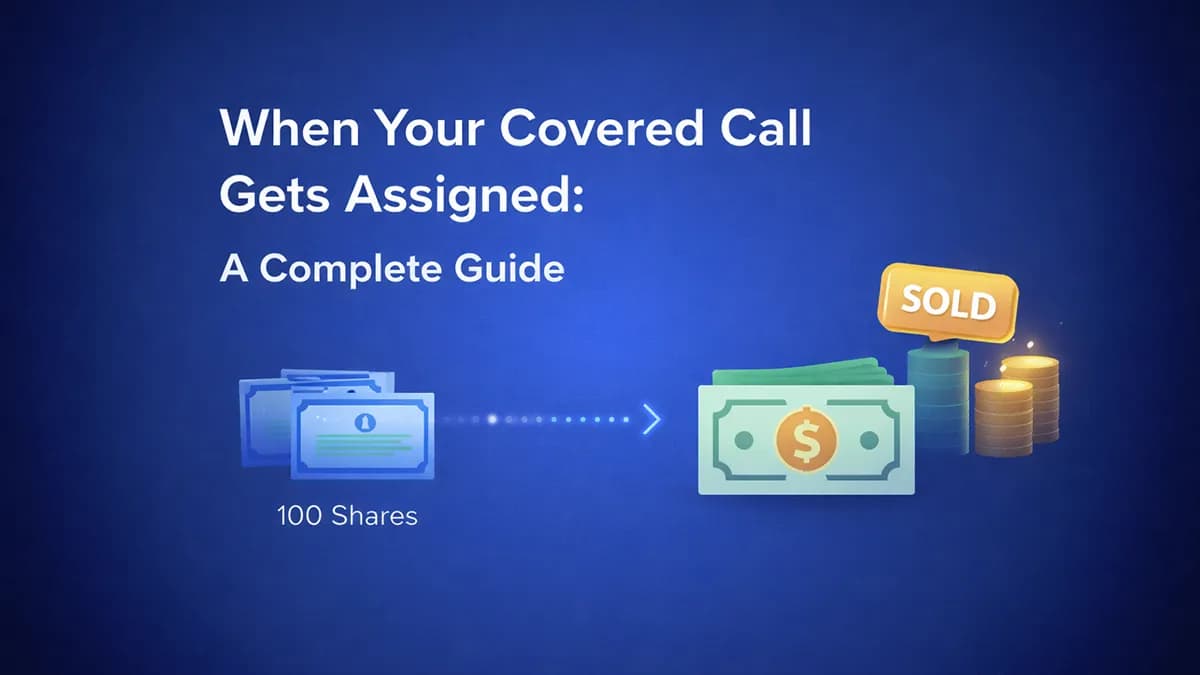
A covered call is assigned when it finishes in-the-money — the stock is above your strike at expiration — and your 100 shares per contract are sold (called away) at the strike. Assignment usually means your trade hit maximum profit: you keep the premium plus any gain up to the strike. It is only a drawback if you wanted to keep the shares or the stock ran far above your strike; if you would rather not be assigned, you can buy the call back or roll it out and up before expiration. Early assignment is uncommon but most likely just before an ex-dividend date.
Track your covered call & cash-secured put income with ledger-grade P&L in CoverEdge — free 14-day Pro trial, no card.
Start free trialGetting assigned on a covered call is a normal part of selling options — not a disaster. When assignment happens, your shares are sold at the strike price and you keep all the premium you collected. For many trades, assignment is actually the best outcome. Here's exactly what happens and how to handle it.
Try the math on a real ticker — for free
Plug in any of 200+ tickers and get live premium, annualized yield, breakeven, and assignment P&L instantly. No signup, no credit card.
What Happens When You Get Assigned
When the stock price is above your call's strike at expiration (or the buyer exercises early), your broker automatically sells your 100 shares at the strike price. The mechanics:
- Your 100 shares are sold at the strike price.
- Cash from the sale appears in your account (strike × 100).
- The option disappears from your positions.
- You keep the premium you originally collected — it's already yours.
Calculating Your P&L on Assignment
Your total profit on an assigned covered call is:
Total P&L = (Strike − Cost Basis) × 100 + Total Premium Collected
Example: You bought AAPL at $180, sold the $190 call for $3.00. Assigned at $190.
- Stock gain: ($190 − $180) × 100 = $1,000
- Premium: $3.00 × 100 = $300
- Total profit: $1,300
Want the exact figure for your own trade before you sell? The free covered call calculator shows the "if called away" P&L live against your cost basis for any of 200+ tickers.
If you rolled the position multiple times before assignment, you need to include ALL premiums collected across the entire roll chain. This is where tracking in a spreadsheet starts to fail — and where a ledger-based tracker shines.
When Assignment Is a Good Thing
- When the strike is above your cost basis. You profit on the stock AND keep the premium. Best case scenario.
- When you want to exit the position. Assignment is a free sell order at a price you pre-selected.
- When you're running the wheel. Assignment on a covered call means you're back to cash and ready to sell puts again. It's the natural cycle of the wheel strategy.
When Assignment Hurts
- When the strike is below your cost basis. You sell at a loss. This can happen if you sold a call after the stock dropped significantly. Always check your cost basis before selling calls at low strikes.
- When the stock keeps running. If AAPL goes to $210 after you're assigned at $190, you missed $20/share of upside. This is the opportunity cost, not a loss — but it stings.
- Tax impact. Assignment triggers a taxable event. In a taxable account, short-term vs. long-term capital gains rules apply based on how long you held the shares.
How to Handle Assignment in Your Tracker
When assignment occurs, your tracking system needs to: (1) close the option trade as "assigned," (2) remove the shares from your position, (3) recalculate your cost basis accounting for all collected premiums, and (4) record the realized P&L.
CoverEdge has a dedicated assignment confirmation workflow that handles all of this automatically. When you confirm an assignment, the system creates the appropriate ledger entries, recalculates your position's cost basis via the recalc_position_basis function, and records the realized trade with accurate P&L.
Avoiding Unwanted Assignment
- Roll before expiration. If the stock is near your strike and you want to keep your shares, roll the call to a later date and/or higher strike.
- Use wider buffers. Selling calls with 5–8% buffer gives you more room before assignment becomes likely.
- Watch ex-dividend dates. Deep ITM calls have higher early assignment risk just before ex-dividend dates as arbitrageurs exercise to capture the dividend.
Frequently asked questions
When do covered calls get assigned?
A covered call is most likely to be assigned when it's in the money at expiration — meaning the stock price is above your strike. Early assignment before expiration is possible but uncommon; it usually happens right before an ex-dividend date when the call's remaining time value is smaller than the dividend, making it worthwhile for the holder to exercise early and capture the dividend.
What happens when my covered call is assigned?
Your 100 shares per contract are sold (called away) at the strike price. You keep the premium you originally collected plus any gain from your cost basis up to the strike. The option position closes and the shares leave your account. Your broker typically processes assignment overnight after expiration, and you'll see the stock sale in your account the next morning.
Is covered call assignment a bad thing?
Not usually. Assignment means your trade hit its maximum profit: you collected the premium and sold the shares at the strike you chose. It's only a downside if you wanted to keep the shares (for instance, to avoid triggering a taxable gain) or if the stock ran far above your strike and you gave up upside. If you don't want to be assigned, you can roll the call out and up before expiration.
Can I avoid assignment on a covered call?
Yes — buy the call back to close before expiration, or roll it (buy to close the current call and sell to open a new one further out in time and/or at a higher strike). Rolling lets you keep your shares and often collect additional net credit, though if the stock has moved well above your strike you may have to accept a small debit to roll up.
Track every premium dollar with CoverEdge
AI-enhanced research, assignment-aware roll analysis, and ledger-grade P&L that survives every roll, close, and assignment. Decision-support, not advice — you decide.
No credit card required · Cancel anytime