Rolling Covered Calls: When, Why, and How
Key takeaway
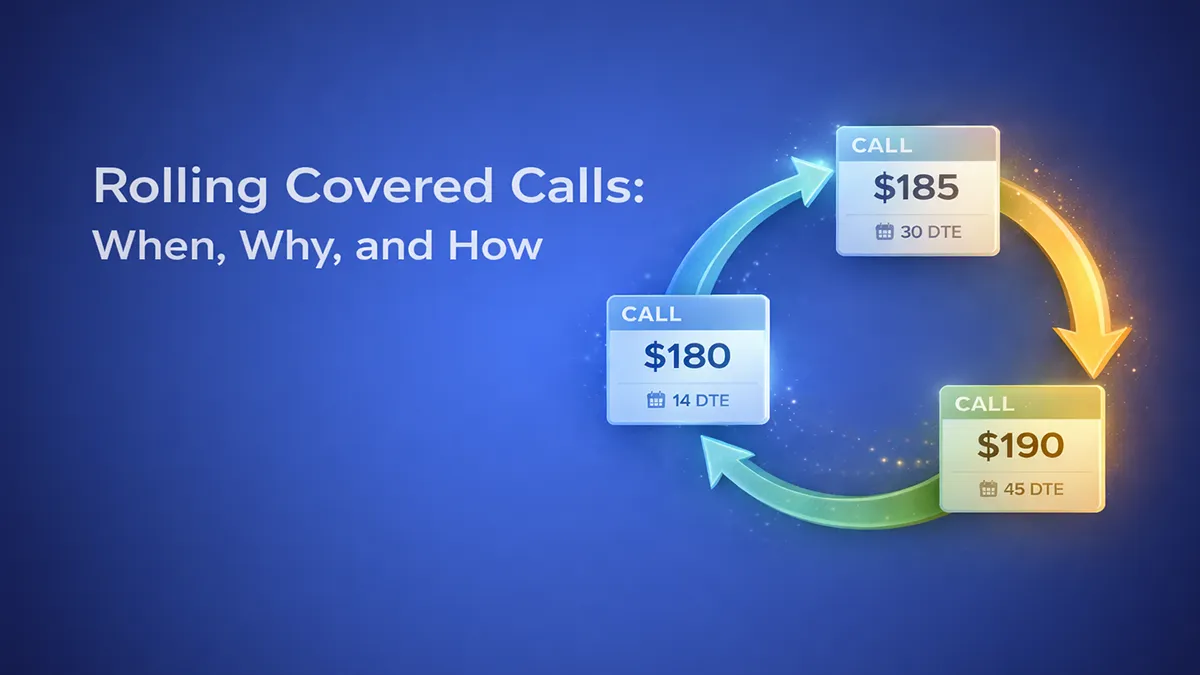
Rolling a covered call means buying back your current short call and selling a new one — usually further out in time and at the same or a higher strike — to collect additional premium and delay or avoid assignment. Roll for a net credit when the stock has risen toward your strike and you still want to keep the shares. Avoid rolling at a net debit just to dodge assignment; if the math no longer works, taking assignment is often the cleaner outcome.
Track your covered call & cash-secured put income with ledger-grade P&L in CoverEdge — free 14-day Pro trial, no card.
Start free trialRolling a covered call means buying back your current short call and selling a new one — usually at a later expiration, and sometimes a higher strike. It's the most powerful tool in a covered call seller's toolkit, and the most misunderstood. The single number that decides whether a roll is worth it is the net credit: rolling for a credit while you still want to keep the shares extends your income, while paying a net debit just to dodge assignment usually makes the position worse. This guide covers when to roll, how rolling out and up-and-out work, when to take assignment instead, and how to track a roll chain's cumulative P&L.
Try the math on a real ticker — for free
Plug in any of 200+ tickers and get live premium, annualized yield, breakeven, and assignment P&L instantly. No signup, no credit card.
When Should You Roll a Covered Call?
- The stock is approaching your strike. If assignment is likely and you want to keep your shares, rolling out (and possibly up) gives you more time and a higher sell price.
- To extend income. If a trade is going well and the option has little value left, close it early and open a new one to keep the income flowing.
- To recover from a drop. If the stock dropped and your call is nearly worthless, close it for a small debit and sell a new call at a lower strike or later date to collect more premium.
How Rolling a Covered Call Works
Every roll is the same two-legged trade — buy to close the call you're short, then sell to open a new one. What changes is where you open the new call. The three common patterns below cover almost every situation.
Roll Out (Same Strike, Later Date)
You keep the same strike but extend the expiration. This is the simplest roll — you're buying time. The net credit is the difference between the new premium and the cost to close the old one.
Roll Up and Out (Higher Strike, Later Date)
You move to a higher strike AND a later expiration. This is the "defensive roll" — you're giving yourself more room while still collecting premium. The trade-off: rolling up usually means a smaller net credit because higher strikes have lower premiums.
Roll Down (Lower Strike, Same or Later Date)
After a stock drop, you can roll to a lower strike to collect more premium. Be cautious: if you roll below your cost basis, assignment would lock in a loss. Always check your cost basis before rolling down.
The Mechanics of a Roll
A roll is two transactions executed together:
- Buy to close your current call (debit).
- Sell to open a new call (credit).
Your broker may let you execute these as a single "roll order." The key number is the net credit — the premium received minus the cost to close. You want this to be positive whenever possible.
To find the highest-net-credit replacement contract, scan the free covered call screener — it ranks live setups across 200+ tickers by annualized yield and probability of expiring out-of-the-money, so you can pick a roll target that pays without parking you below your cost basis.
A Worked Roll Example (Net Credit)
Say you own 100 shares and you're short one call at the $50 strike expiring this Friday. The stock has climbed to $49.50 and assignment is looking likely, but you still want to keep the shares. You decide to roll out and up — same-week buy-to-close, then sell a new call one month out at the $52.50 strike:
- Buy to close the current $50 call: costs $1.20 ($120).
- Sell to open the new $52.50 call a month out: collects $1.60 ($160).
- Net credit = $1.60 − $1.20 = $0.40 ($40 per contract in your pocket).
That single roll did three things: it took in a $40 net credit, it lifted your assignment price by $2.50 (from $50 to $52.50 — an extra $250 of upside if the shares are called away), and it bought you another month. The trade only makes sense because the net was a credit and the new strike still sits above your cost basis. Flip the two premiums — pay $1.60 to close and collect $1.20 — and you'd be rolling for a $40 debit, paying out of pocket just to delay assignment, which is the trap the next section covers.
Roll Chain Tracking
After rolling the same position 3–4 times, tracking gets complex. You need to know your cumulative net P&L across the entire chain, not just the current contract. Did the chain as a whole make or lose money? What's the total premium collected if you eventually get assigned?
This is where spreadsheets break down. CoverEdge tracks roll chains natively — every rolled trade links back to the one it replaced, and the cumulative net P&L is visible at every stage. When assignment finally happens, the realized trade accounts for every premium across the chain.
Can You Roll a Covered Call for a Debit?
You can, but you usually shouldn't. A net-debit roll means the cost to close your current call is larger than the premium you collect on the new one — so you're paying out of pocket to extend the trade. That quietly erodes the income the strategy exists to produce. The one defensible reason to accept a small debit is to move a strike back above your cost basis so a future assignment locks in a profit instead of a loss. Rolling for a debit purely to postpone assignment is almost always worse than simply letting the shares be called away.
Rolling vs. Assignment: Which Is Better?
Rolling isn't automatically the "save." The cleaner outcome depends entirely on where your strike sits relative to your cost basis:
- Strike above your cost basis. Taking assignment locks in a gain plus every dollar of premium you collected. That's a win, not a failure — don't pay to avoid it.
- You still want the shares and can roll for a credit. Rolling out (or up and out) keeps the position and pays you to wait. This is the case rolling is built for.
- The thesis is broken. Neither roll nor hold — close the whole position and move on.
The decision comes down to one question: does rolling both pay you a credit and keep your reason for owning the stock intact? If not, assignment is usually the better outcome. Our covered call assignment guide walks through the full decision.
When NOT to Roll
- When you'd roll for a net debit. If closing the old call costs more than the new premium, you're paying to extend. Sometimes it's better to let assignment happen.
- When the stock has fundamentally changed. If the thesis for owning the stock is broken, don't roll — exit the position entirely.
- When assignment is actually a good outcome. If the strike is well above your cost basis, getting assigned means locking in a profit. Read our assignment guide to evaluate.
AI-Powered Roll Analysis
CoverEdge Pro includes assignment-aware roll analysis. For each open trade nearing expiration, CoverEdge evaluates the stock's technical setup, your cost basis, and available contracts to surface one of four scenario flags: Let Assign, Let Expire, Roll, or Review. It calculates safe strikes (above your cost basis), target DTE, and expected net credit — informational analysis, not advice, so you can make your own call.
Related Reading
Rolling is most often a response to looming assignment — see our covered call assignment guide to decide when to roll versus let the shares go, and why a dedicated tracker beats a spreadsheet once a roll chain gets long.
Frequently asked questions
When should you roll a covered call?
Roll a covered call when the stock is approaching your strike, you still want to keep the shares, and a new contract further out in time pays a net credit. Rolling also makes sense to keep income flowing when the current call has little time value left. If the roll would cost a net debit or your reason for owning the stock has changed, it is usually better to let the trade expire or take assignment.
How does rolling a covered call work?
A roll is two trades executed together: you buy to close your current short call (a debit) and sell to open a new one (a credit), usually at a later expiration and sometimes a higher strike. Most brokers let you enter this as a single roll order. The number that matters is the net credit — the new premium minus the cost to close — which you want to be positive whenever possible.
Should you roll a covered call for a debit?
Usually not. Paying a net debit to roll means you are spending money to delay an outcome, which quietly erodes the income the strategy is supposed to generate. A debit roll can be justified to move a strike back above your cost basis, but rolling for a debit purely to avoid assignment is often worse than simply letting the shares be called away.
Is it better to roll or take assignment?
Take assignment when the strike is above your cost basis — being called away locks in a profit plus all the premium collected. Roll instead when you still want to hold the shares and can do so for a net credit. Rolling only makes sense when it both pays you and keeps your thesis for owning the stock intact.
Does rolling a covered call reset the holding period?
Rolling the option does not reset the holding period on your underlying shares. It does close one option and open another, which has its own tax implications, so consult a tax professional for your specific situation.
Track every premium dollar with CoverEdge
AI-enhanced research, assignment-aware roll analysis, and ledger-grade P&L that survives every roll, close, and assignment. Decision-support, not advice — you decide.
No credit card required · Cancel anytime