The Wheel Strategy Explained: A Step-by-Step Walkthrough
Key takeaway
The wheel strategy is a repeating income cycle: you sell a cash-secured put on a stock you would be happy to own, and if assigned you buy 100 shares at the strike, then sell covered calls against those shares until they are called away — at which point you start over with a new put. Every leg collects premium, so the wheel generates income whether you end up holding the stock or not. It only works on quality names you genuinely want to own, because assignment on the put side means taking delivery of the shares.
Track your covered call & cash-secured put income with ledger-grade P&L in CoverEdge — free 14-day Pro trial, no card.
Start free trialThe wheel strategy is a systematic approach to generating options income by combining two strategies: selling cash-secured puts and selling covered calls. You "wheel" between the two sides — collecting premium at every step — while building positions in stocks you want to own. It's the strategy behind most of the r/thetagang community, and it's what CoverEdge was built to track.
Try the math on a real ticker — for free
Plug in any of 200+ tickers and get live premium, annualized yield, breakeven, and assignment P&L instantly. No signup, no credit card.
New to the put side of the wheel? Start with our deep dive on cash-secured puts — that's Phase 1 of every wheel cycle.
How the Wheel Strategy Works
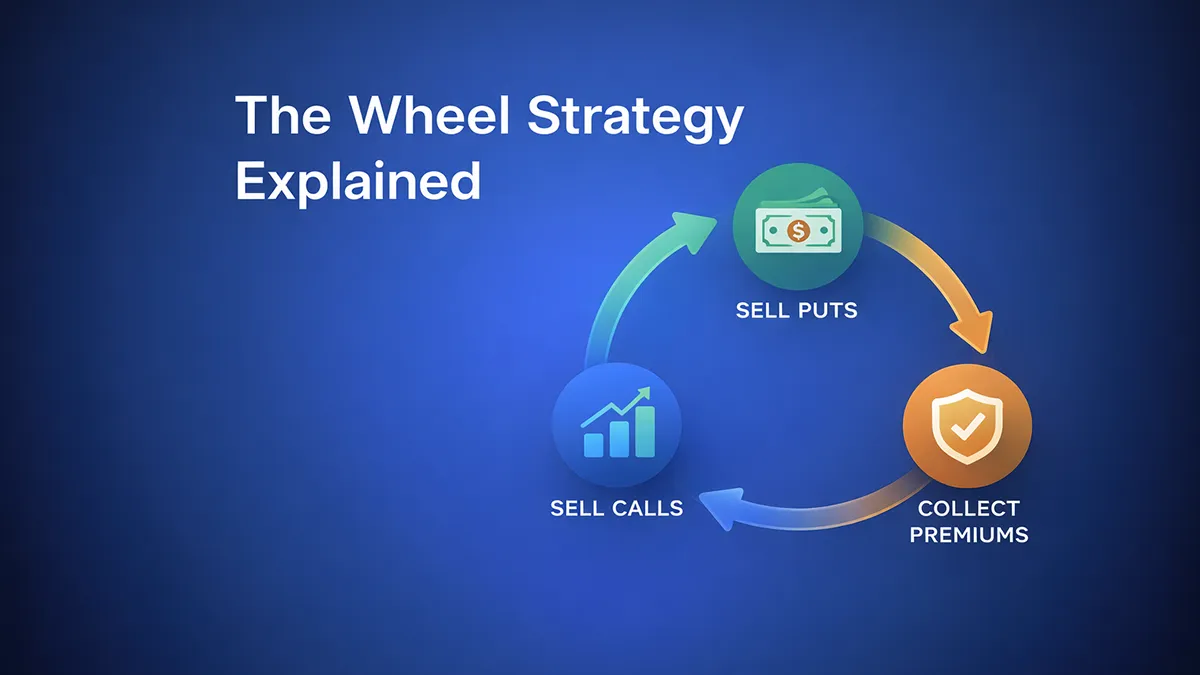
The wheel has three phases that repeat cyclically:
- Phase 1 — Sell a cash-secured put. Pick a stock you want to own. Sell a put at a strike price you'd be happy buying at. Collect the premium. If the stock stays above the strike, the put expires worthless and you keep the premium. Repeat.
- Phase 2 — Get assigned. If the stock drops below the strike, you buy 100 shares at the strike price. Your effective cost basis is the strike minus all premiums collected from puts.
- Phase 3 — Sell covered calls. Now that you own shares, sell covered calls against them. Collect premium. If the stock rises above the call strike, your shares get called away and you're back to Phase 1 with cash. If not, keep selling calls.
Wheel Strategy Example
Let's walk through a full wheel cycle on SOFI at $10:
- Sell $9.50 put for $0.40 ($40 premium). Stock stays above $9.50 — put expires. Net income: $40.
- Sell another $9.50 put for $0.35 ($35 premium). Stock drops to $9.20 — you get assigned 100 shares at $9.50. Net cost basis: $9.50 − $0.75 total premiums = $8.75.
- Sell $10 covered call for $0.45 ($45 premium). Stock rises to $10.50 — shares called away at $10. Profit: ($10 − $8.75) × 100 + $45 = $170.
- Back to Phase 1 with $1,000 cash + $170 profit. Start again.
Why the Wheel Strategy Works for Income
The wheel generates income in every market condition. In a flat market, your puts and calls expire worthless and you keep premiums. In a rising market, your calls get assigned and you profit from stock appreciation plus premiums. In a falling market, you buy stocks at a discount (through put assignment) and immediately start lowering your cost basis with call premiums.
The key insight: you only wheel stocks you want to own at the put strike price. This makes assignment a feature, not a risk. You're never forced into a position you don't want.
Choosing Stocks for the Wheel
- Moderate IV (25–60%): Enough premium to be worth selling, not so volatile that assignment becomes painful.
- Liquid options: Tight bid/ask spreads, multiple expirations.
- Fundamentally sound: You must be comfortable owning the stock long-term.
- $5–$50 price range: Keeps capital requirements manageable (one put requires $500–$5,000 in cash).
For wheel-specific ticker ideas, see our ranked list of the best stocks for the wheel strategy, or our broader guide on best stocks for covered calls for the call side.
Or screen live setups yourself: the free cash-secured put screener ranks the entry leg (Phase 1) and the covered call screener ranks the exit leg (Phase 3) — both across 200+ tickers, refreshed through the trading day.
The Wheel vs Covered-Call ETFs
A common question from investors looking at the wheel for the first time: why not just buy JEPI or QYLD and let the fund manager run the strategy? The honest answer is that ETF wrappers solve the operational pain but cost you 1–3% per year in after-tax yield, plus full control over delta and stock selection. We break down the math (including the ordinary-vs-qualified-dividend tax drag) in our JEPI & QYLD vs DIY covered calls comparison. For most taxable accounts, running the wheel yourself wins — provided you have a tracker that can keep up with the assignment-and-roll cycle.
Tracking the Wheel Strategy
The wheel involves puts AND calls on the same underlying, with assignment events that convert puts into stock positions. This is notoriously hard to track in a spreadsheet. CoverEdge handles both sides natively — covered calls and cash-secured puts with identical feature parity, automatic cost basis recalculation through assignments, and roll chain tracking across the full wheel cycle. For a step-by-step breakdown of every leg a complete cycle produces — and the double-counting trap that inflates most wheel spreadsheets — see our guide to using a wheel strategy tracker.
Common Wheel Strategy Mistakes
- Wheeling stocks you don't want to own. Never sell puts just for the premium — you need conviction in the underlying.
- Ignoring earnings dates. Selling options through earnings dramatically increases assignment risk due to big price swings.
- Setting strikes too aggressively. ATM puts maximize premium but guarantee more assignments. Start with puts 5–10% OTM.
- Not tracking cumulative P&L. The wheel's real power shows over multiple cycles. If you're not tracking cumulative premiums, you can't measure success.
Related Reading
Ready to put it into practice? See our ranked list of the best stocks for the wheel strategy, the deep dive on cash-secured puts (Phase 1 of every cycle), and how to manage roll chains across the full wheel. If you are still deciding which leg to sell first, the covered call vs cash-secured put comparison breaks down the choice.
Frequently asked questions
Is the wheel strategy profitable?
When executed on quality stocks with disciplined strike selection, many wheel practitioners report 15–30% annualized returns. Results depend heavily on stock selection and market conditions — the wheel only works on names you genuinely want to own at your put strike.
How much capital do you need for the wheel strategy?
Each cash-secured put requires enough cash to buy 100 shares at the strike. For a $10 stock that's $1,000 per contract; for a $50 stock it's $5,000. Most traders start with $5,000–$10,000 so they can diversify across two or three lower-priced underlyings.
Can CoverEdge track the wheel strategy?
Yes. CoverEdge tracks both covered calls and cash-secured puts with full lifecycle management, automatic cost-basis recalculation through assignments, and roll-chain history across the entire wheel cycle — the part that breaks most spreadsheets.
Track every premium dollar with CoverEdge
AI-enhanced research, assignment-aware roll analysis, and ledger-grade P&L that survives every roll, close, and assignment. Decision-support, not advice — you decide.
No credit card required · Cancel anytime