Cash-Secured Puts: The Complete 2026 Guide
Key takeaway
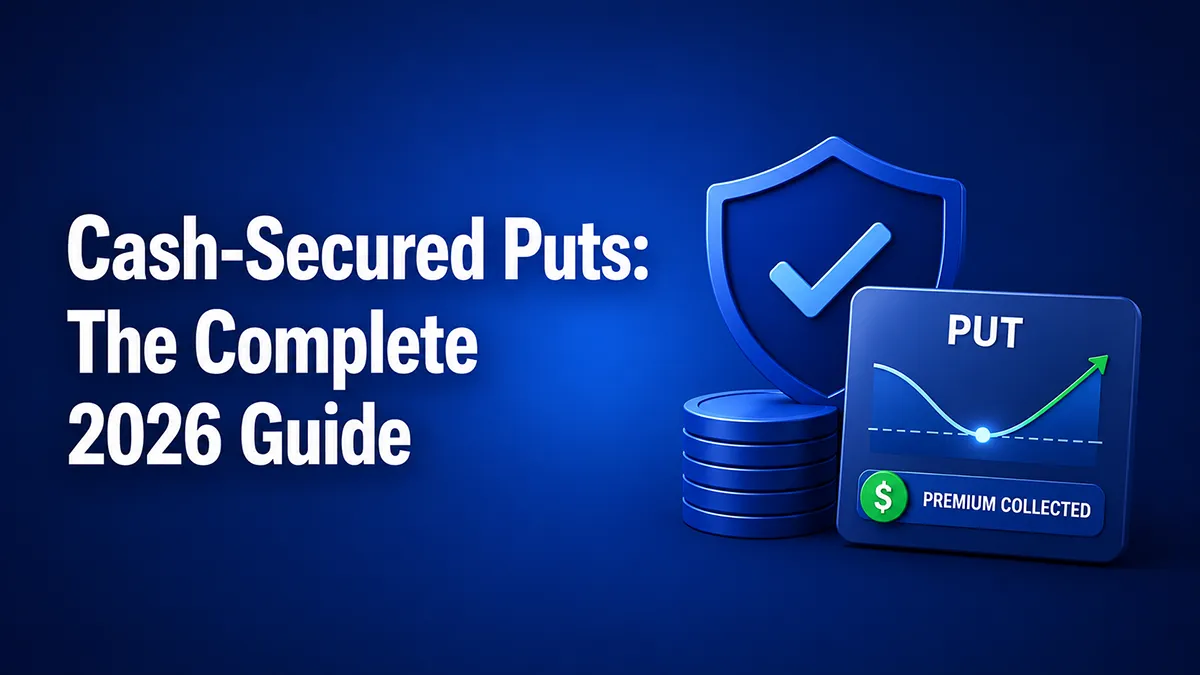
A cash-secured put is an income strategy where you sell a put option on a stock you would be happy to own and set aside enough cash to buy 100 shares at the strike if assigned, collecting the premium up front. If the stock stays above the strike the put expires worthless and you keep the premium; if it falls below, you buy the shares at an effective cost basis of the strike minus the premium. Each contract reserves the strike times 100 in cash, so only sell puts at a price you would genuinely be glad to pay for the shares.
Track your covered call & cash-secured put income with ledger-grade P&L in CoverEdge — free 14-day Pro trial, no card.
Start free trialA cash-secured put is the mirror image of a covered call — and the entry point to half of the wheel strategy. You sell a put option on a stock you'd be happy to own, set aside enough cash to buy 100 shares at the strike, and collect premium income. If the stock stays above the strike, you keep the premium. If it dips below, you buy quality shares at a discount. Either way, you get paid to wait.
Last reviewed June 2026.
Try the math on a real ticker — for free
Plug in any of 200+ tickers and get live premium, annualized return, breakeven, and effective cost basis instantly. No signup, no credit card.
How Selling Cash-Secured Puts Works
The mechanics in four steps:
- Pick a stock you actually want to own. Cash-secured puts are not speculation — they're a buy-the-dip system with a built-in income stream.
- Choose a strike price below today's price at a level you'd gladly pay. For a stock at $50, you might sell the $47 put (6% below market).
- Set aside the collateral. The put is "cash-secured" because you reserve enough cash to buy 100 shares at the strike — $4,700 in the example above.
- Collect the premium and wait. If the stock stays above $47 at expiration, the put expires worthless and you keep the entire premium. If it dips below, you get assigned 100 shares at $47, with a true cost basis of $47 minus premium.
Cash-Secured Put Example with Real Numbers
Suppose AMD is trading at $155. You sell the 30-day $145 put for $2.10, collecting $210 in premium. You set aside $14,500 in cash as collateral. Three possible outcomes:
- AMD stays above $145: Put expires worthless. You keep the $210. Return on collateral: 1.45% in 30 days, or ~17.4% annualized — without ever owning the stock.
- AMD dips to $142: You're assigned 100 shares at $145. True cost basis: $145 − $2.10 = $142.90. You bought a dip in a quality name at an effective price 7.8% below where it started.
- AMD crashes to $120: You're still assigned at $145. Cost basis $142.90, current value $120 — an unrealized loss of $2,290. The premium softens it but doesn't eliminate it. This is why stock selection matters.
Cash-Secured Put vs Covered Call: What's the Difference?
Both are short-premium strategies that benefit from theta decay. The structural difference is what you collateralize with (our full covered call vs cash-secured put comparison walks through a same-strike example where the payoffs match):
- Covered call = sell a call against 100 shares you already own. Collateral is the stock itself.
- Cash-secured put = sell a put against cash equal to 100 shares at the strike. Collateral is cash.
For tax and risk purposes, they have a similar profit/loss profile at expiration. The main practical difference: a covered call is the natural strategy when you already own shares, while a cash-secured put is the natural strategy when you want shares but at a better entry price.
Choosing the Right Strike Price
Strike selection drives every outcome. The same framework from our covered call strike guide applies in reverse:
- Delta 0.30 puts: ~30% chance of assignment. Balanced premium with a real buffer. The most common "wheel" entry.
- Delta 0.15–0.20 puts: Lower premium, lower assignment risk. Best for stocks you'd rather collect income on than actually own.
- Delta 0.40–0.50 puts: Aggressive entry, near-the-money. High premium and high probability of assignment. Use only when you genuinely want to be assigned.
Risks of Selling Cash-Secured Puts
Cash-secured puts have the same downside profile as owning the stock outright below the strike. The premium softens the blow but doesn't eliminate it. Key risks:
- Gap-down risk. A bad earnings report or geopolitical shock can blow through your strike overnight. The premium might cover 1% of a 15% gap-down.
- Opportunity cost on collateral. $14,500 set aside on a single put earns nothing else (besides T-bill yield if your broker pays it). Sizing matters.
- Assignment timing. American-style equity puts can be exercised early, but unlike calls there is no ex-dividend incentive. It is most likely when a put is deep in the money near expiration.
Managing a Put That Moves Against You
If the stock falls toward or below your strike, you can close the put, accept assignment, or move the obligation to a different contract. The guide to how to roll a cash-secured put explains rolling down, out, or down-and-out, including the net-credit math and why a new premium does not erase the cost of closing the old leg.
Tracking Cash-Secured Puts Properly
Tracking puts is harder than tracking calls because of the cash collateral. Most spreadsheets either (a) ignore the collateral and inflate your return, or (b) double-count when assignment converts cash into shares. CoverEdge handles both sides of the wheel natively — every put trade is treated with the same lifecycle as a covered call, and when assignment converts cash into a stock position, the new cost basis is automatically calculated through the ledger.
Best Stocks for Cash-Secured Puts
The strategy lives or dies on stock selection — you only want to sell puts on names you'd be glad to own at the strike. For a ranked shortlist of candidates by liquidity, IV, and price (including small-account picks under $50), see our guide to the best stocks for cash-secured puts, or jump straight to the live cash-secured put screener to rank setups across 200+ tickers right now.
Frequently asked questions
What is a cash-secured put?
A cash-secured put is an options income strategy where you sell (write) a put option on a stock you'd be happy to own and set aside enough cash to buy 100 shares at the strike price if assigned. You collect the premium up front. If the stock stays above the strike, the put expires worthless and you keep the premium; if it falls below, you buy the shares at the strike — at an effective cost basis of the strike minus the premium received.
How much capital do I need to sell cash-secured puts?
Strike price × 100. For a $20 stock, that's $2,000 of reserved cash per contract; for a $400 stock it's $40,000. The cash is held as collateral so the put is fully secured. Most traders start with $5,000–$10,000 so they can diversify across two or three lower-priced underlyings rather than tying everything up in a single name.
What's the difference between a cash-secured put and a naked put?
A cash-secured put has enough cash reserved to buy the shares if assigned, so your maximum loss is defined and identical to buying the stock at the strike (minus the premium). A naked put relies on margin instead of reserved cash, magnifying both leverage and risk. Naked puts generally require a margin account and a higher options-approval level.
Can I roll a cash-secured put?
Yes. Rolling down and out — buying back the current put and selling a new one at a lower strike and later expiration — is the most common defensive move when a put goes in-the-money but you don't want to be assigned yet. The same rolling principles that apply to covered calls apply to puts; aim to roll for a net credit whenever possible.
Track every premium dollar with CoverEdge
AI-enhanced research, assignment-aware roll analysis, and ledger-grade P&L that survives every roll, close, and assignment. Decision-support, not advice — you decide.
No credit card required · Cancel anytime