How to Pick the Right Strike Price for Covered Calls
Key takeaway
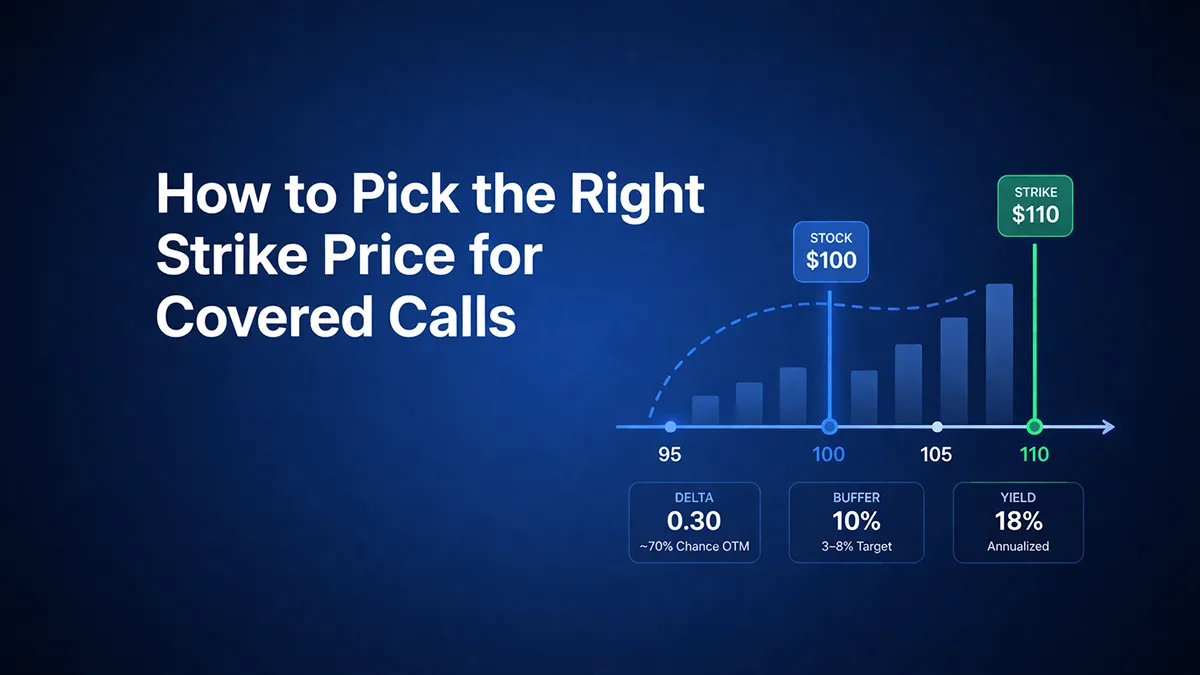
To pick a covered call strike, balance three levers: delta (which approximates the odds of assignment), the downside buffer (how far out-of-the-money the strike sits), and premium yield. A common starting point is a strike around 0.30 delta — roughly a 30% chance of finishing in-the-money — which collects meaningful premium while leaving room for upside. Choose a closer, higher-delta strike when you want more income and are willing to be called away, and a further, lower-delta strike when you would rather keep the shares.
Track your covered call & cash-secured put income with ledger-grade P&L in CoverEdge — free 14-day Pro trial, no card.
Start free trialChoosing the right strike price is the single most important decision in covered call selling. Go too close to the current price and you maximize premium but almost guarantee assignment. Go too far out and your premium barely covers the risk of holding the stock. Here's a repeatable framework for picking the right strike every time.
Try the math on a real ticker — for free
Plug in any of 200+ tickers and get live premium, annualized yield, breakeven, and assignment P&L instantly. No signup, no credit card.
The Three Factors That Determine Your Strike
1. Delta — Your Probability Compass
Delta tells you how sensitive the option price is to a $1 move in the stock — but it also approximates the probability of expiring in-the-money. A 0.30 delta call has roughly a 30% chance of assignment.
- Conservative: 0.15–0.20 delta (low premium, low assignment risk)
- Balanced: 0.25–0.35 delta (moderate premium, moderate risk)
- Aggressive: 0.40–0.50 delta (high premium, high assignment chance)
Most experienced sellers land in the 0.25–0.35 range — enough premium to be meaningful, with a 65–75% probability of the option expiring worthless.
2. Buffer Percentage — Your Cushion
Buffer is the percentage distance between the current stock price and your strike. A $100 stock with a $110 strike has a 10% buffer. This tells you how much the stock can rise before your shares get called away.
In practice, target 3–8% buffer for 30-day expirations. Less than 3% offers very little room. More than 8% often means premium is too thin to justify the position.
3. Premium Yield — Your Return
Premium yield = (premium ÷ stock price) × (365 ÷ DTE). This annualizes your return so you can compare opportunities across different stocks and expiration dates. Most sellers target 12–36% annualized yield. Use the free covered call calculator to run the numbers on any ticker, or read the return formulas in full.
Strike Selection Decision Framework
| Market Outlook | Delta Range | Buffer | Trade-off |
|---|---|---|---|
| Bearish → Flat | 0.40–0.50 | 1–3% | Max premium, high assignment |
| Neutral | 0.25–0.35 | 3–6% | Balanced risk/reward |
| Mildly Bullish | 0.15–0.20 | 6–10% | Low premium, lets stock run |
When to Adjust Your Strike
- Before earnings: Widen your buffer or skip the cycle entirely. Earnings moves can blow through any strike.
- High IV environment: You can afford a wider buffer because premiums are richer.
- Low IV environment: Tighter strikes may be necessary to make the premium worthwhile.
- After a big drop: Be careful selling calls near your cost basis. If the stock is underwater, a too-low strike could lock in a loss on assignment.
Using a Covered Call Screener
Manually scanning option chains for the right delta, buffer, and yield is tedious. The free covered call screener ranks live setups across 200+ tickers by delta, buffer, and annualized yield, while CoverEdge's research tool adds IV percentile and RSI context, and provides AI-enhanced strike analysis for the risk preset you choose (conservative, balanced, or aggressive).
FAQ
What delta should I use for covered calls?
0.25–0.35 is the sweet spot for most sellers. This gives you a 65–75% chance of keeping your shares while still collecting meaningful premium. Adjust based on your market outlook and risk tolerance.
Should I sell weekly or monthly covered calls?
Monthly (30 DTE) offers a better premium-to-risk ratio because theta decay accelerates in the last 2 weeks. However, weekly calls give you more flexibility to adjust strikes. Many sellers compromise with 14–21 DTE expirations. For a full comparison of the trade-offs, see how to pick the best DTE for covered calls.
Track every premium dollar with CoverEdge
AI-enhanced research, assignment-aware roll analysis, and ledger-grade P&L that survives every roll, close, and assignment. Decision-support, not advice — you decide.
No credit card required · Cancel anytime