JEPI & QYLD vs Selling Your Own Covered Calls in 2026
Key takeaway
JEPI and QYLD package covered-call income into a fund, trading control and after-tax efficiency for convenience: QYLD sells at-the-money calls on the whole Nasdaq-100 and structurally caps upside, while JEPI is more balanced but still hands you ordinary-income distributions. Selling your own covered calls on 5-10 names you want to own has historically beaten these ETFs by roughly 1-4% annualized after tax for accounts of about $25k or more, at the cost of effort. The funds win for small or hands-off accounts; DIY wins for engaged investors who want control and tax flexibility.
Track your covered call & cash-secured put income with ledger-grade P&L in CoverEdge — free 14-day Pro trial, no card.
Start free trialJEPI, QYLD, and the broader family of covered call ETFs have exploded past $50 billion in combined AUM by promising one thing: passive monthly income from a strategy that used to require active management. So why do experienced premium sellers still write their own calls? This guide compares JEPI vs selling covered calls yourself across yield, tax efficiency, control, and total return — with the math to back every claim.
Try the math on a real ticker — for free
Plug in any of 200+ tickers and get live premium, annualized yield, breakeven, and assignment P&L instantly. No signup, no credit card.
What Are Covered Call ETFs?
Covered call ETFs hold an underlying basket of stocks (S&P 500, Nasdaq-100, or a proprietary "low-vol" sleeve) and systematically sell calls against the portfolio. The premium is distributed monthly. The three biggest products as of 2026:
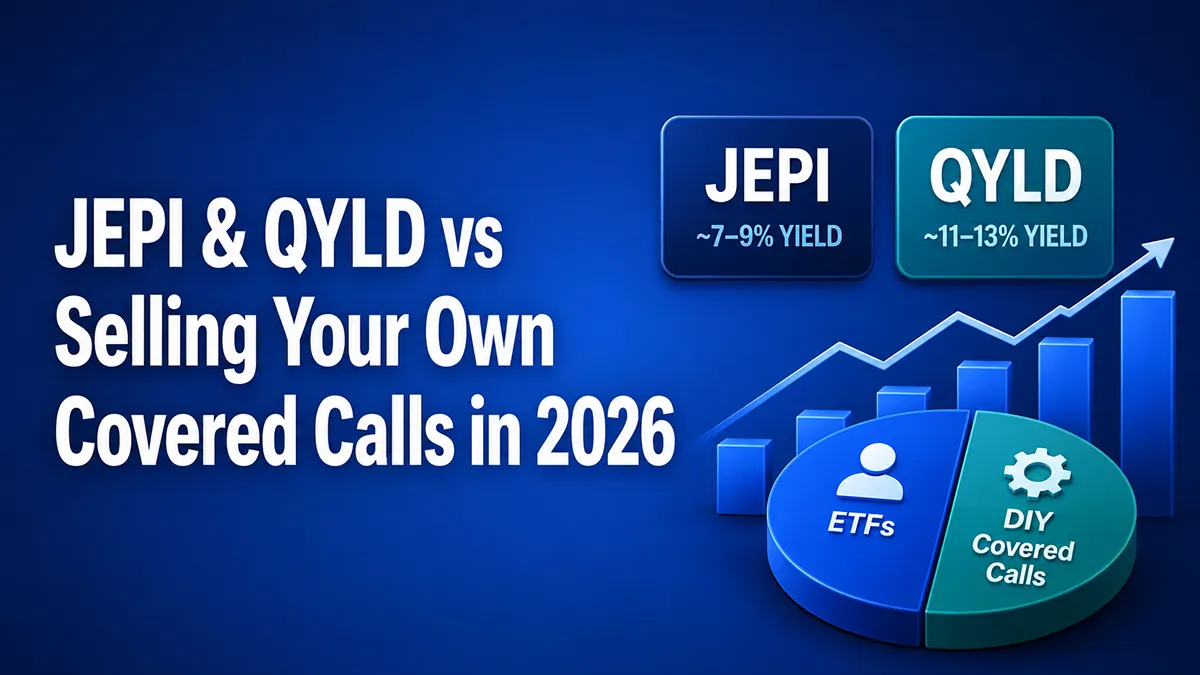
- JEPI (JPMorgan Equity Premium Income) — S&P 500-ish basket, sells out-of-the-money calls via equity-linked notes. ~7–9% yield. ~0.35% expense ratio.
- QYLD (Global X Nasdaq 100 Covered Call) — owns the NDX, sells ATM monthly calls on 100% of the portfolio. ~11–13% yield. 0.60% expense ratio.
- XYLD (Global X S&P 500 Covered Call) — same approach on the SPX. ~9–11% yield. 0.60% expense ratio.
The Headline Yield Is Misleading
QYLD's 12% distribution yield looks irresistible compared to a 2% S&P 500 dividend yield. But the distribution is not free money — it's capped upside being paid back to you. Since QYLD sells ATM calls on 100% of its holdings every month, it caps almost all upside while keeping all downside. Over the trailing 5 years (2021–2025), QYLD produced a total return of roughly 30% while QQQ produced roughly 90%. The 12% yield came at the cost of two-thirds of the underlying market's return.
JEPI is more sophisticated — it sells out-of-the-money calls via ELNs, keeping some upside. JEPI's 5-year total return has roughly matched the S&P 500 with lower volatility and a higher distribution yield. But you're paying 35 bps annually and accepting a wrapper you can't customize.
JEPI vs Selling Covered Calls Yourself: The Real Comparison
| Factor | JEPI / QYLD | DIY Covered Calls |
|---|---|---|
| Effort | Buy once, hold forever | Weekly or monthly trade management |
| Strike selection | You don't choose — the fund does | You pick delta, DTE, and IV percentile |
| Stock selection | Forced into the fund's basket | Sell only on names you actually want to own |
| Yield (target) | 7–13% distributions | 12–36% annualized on quality names |
| Tax efficiency | Mostly ordinary income; ROC murkiness | Short-term capital gain (or LT if structured) |
| Annual cost | 0.35–0.60% expense ratio + spreads | $0 (or fixed commission < 1 bp) |
| Downside hedging | None — fund holds the full beta | You can avoid earnings, skip weak weeks |
Tax: Where the ETFs Quietly Lose
JEPI's distributions are mostly taxed as ordinary income because of the equity-linked note structure — meaning rates up to 37% rather than the 0/15/20% long-term capital gains rates. QYLD has historically distributed a large "return of capital" component, which lowers your cost basis instead of generating immediate tax, but defers the bill rather than eliminating it.
DIY covered calls, by contrast, generate short-term capital gain on the premium and long-term capital gain on the stock (when structured properly — see our covered call tax guide). For a high-income trader, the after-tax delta can easily be 1–3% per year in favor of DIY.
Where the ETFs Actually Win
Owning JEPI or QYLD isn't a mistake — there are real use cases:
- Time-constrained investors. If you genuinely can't spend 15 minutes a week managing positions, a fund is better than no premium strategy at all.
- Small accounts. Below ~$10k, you can't diversify across 3–4 underlyings to sell calls properly. An ETF gives you instant diversification.
- Retirement accounts where options approval is denied. Some IRA custodians block options entirely.
- Behavioral hedge. Some investors will close DIY positions in a panic but won't sell an ETF. If you know yourself, the fund wrapper has value.
The Hybrid Approach
Many serious income investors run both. Use JEPI/JEPQ as a core ~30–40% allocation for broad-market premium exposure, then run DIY covered calls and cash-secured puts on 5–10 quality names you've picked yourself. The DIY sleeve is where you control delta, avoid earnings, and capture the after-tax outperformance.
How to Track DIY Premium Income Like a Pro
The reason most retail traders default to ETFs isn't actually performance — it's bookkeeping. Tracking premium, rolls, assignments, and cost basis across 10+ underlyings in a spreadsheet is genuinely painful. CoverEdge was built specifically for the DIY covered-call investor: ledger-first P&L, automatic cost-basis reconciliation, roll chain visualization, and AI-powered roll analysis. It's the "professional infrastructure" gap that pushed people to JEPI in the first place.
Related Reading
If you decide to run your own premium sleeve, start with our ranked list of the best stocks for covered calls, the cash-secured puts guide, and the wheel strategy walkthrough for running both sides on names you actually want to own.
Frequently asked questions
Is JEPI better than selling your own covered calls?
Only on a pre-tax, effort-adjusted basis for small accounts or time-constrained investors. On an after-tax, full-control basis with a portfolio of $25k or more, running your own covered calls has historically beaten JEPI by roughly 1–4% annualized, depending on strike discipline and underlying selection.
Why does QYLD always seem to lose money long-term?
QYLD sells at-the-money calls on 100% of the Nasdaq-100. In a rising market the calls are assigned and the fund participates in almost none of the upside while still owning all of the downside. The high distribution yield comes at the cost of structural capital decay over time.
Can I write covered calls on JEPI or QYLD?
Technically yes — they trade options — but the premium is thin because the underlying basket is already short volatility. You would be selling calls on a portfolio that has already had most of its volatility harvested, so it is generally not worth it.
What's the best alternative to JEPI?
For DIY income investors, the best alternative to JEPI is often JEPI itself as a core holding plus a sleeve of self-managed covered calls and cash-secured puts on 5–10 large-cap names you actually want to own. That captures the after-tax outperformance while keeping the operational simplicity of a fund for the core.
Track every premium dollar with CoverEdge
AI-enhanced research, assignment-aware roll analysis, and ledger-grade P&L that survives every roll, close, and assignment. Decision-support, not advice — you decide.
No credit card required · Cancel anytime