Best High-IV Stocks for Covered Calls in 2026 (Ranked & Updated)
Key takeaway
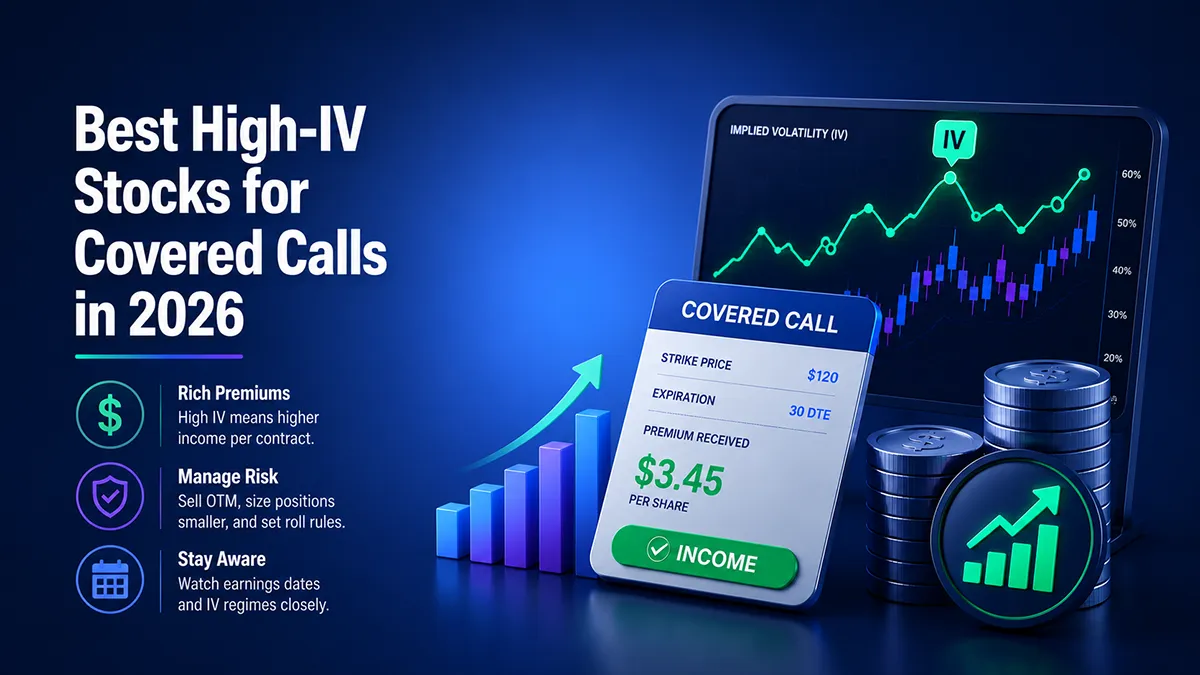
The best high-IV stocks for covered calls pair elevated implied volatility (for the richest premiums) with deep options liquidity and a business you would hold through a drawdown. Liquid high-IV names like NVDA, TSLA, AMD, COIN, and MSTR are common 2026 examples, with the crypto-linked names sitting at the extreme end. High IV is only an advantage if you are comfortable owning the stock through the swings it implies — judge richness by IV percentile (ideally above 50-70), sell further out-of-the-money for a bigger buffer, and size positions smaller than you would on a calm stock.
Track your covered call & cash-secured put income with ledger-grade P&L in CoverEdge — free 14-day Pro trial, no card.
Start free trialThe best high-IV stocks for covered calls pay the richest premiums — but high implied volatility cuts both ways. The same volatility that fattens your premium also raises the odds the stock makes a big move against you. This guide covers what to screen for when chasing premium, a quick-compare table of high-IV 2026 candidates, and how to size the risk so the yield is actually worth it.
Last reviewed September 2026. We refresh this list monthly. IV regimes change fast — confirm current implied volatility, IV percentile, and the next earnings date before you write a call.
Try the math on a real ticker — for free
Plug in any of 200+ tickers and get live premium, annualized yield, breakeven, and assignment P&L instantly. No signup, no credit card.
Why High IV Means Higher Premiums
Implied volatility is the market's forecast of how much a stock will move, and it is the single biggest driver of an option's price. When IV is high, the same strike and expiration pays a much larger premium than it would on a quiet stock. For covered call sellers that means more income per contract — but only if you can stomach the wider price swings that come with it. The goal is to harvest rich premium on names you are still happy to hold through a drawdown. Our study of 93 live covered call setups quantifies the trade-off: across the board, implied volatility and yield moved almost in lockstep (a 0.96 correlation), so a richer premium is compensation for risk, not a free lunch.
What to Screen For in High-IV Covered Calls
- High IV percentile, not just high IV. A stock that is always volatile isn't necessarily a good sell. You want IV that is high relative to the stock's own history — check IV rank or IV percentile to know whether premium is genuinely rich right now.
- Liquid options. High-IV names are often the most heavily traded, but confirm tight spreads and deep open interest so you can roll cleanly.
- A name you would hold anyway. High IV means bigger potential drawdowns. Only sell calls on volatile stocks you are comfortable owning through one.
- Earnings awareness. IV is often highest right before earnings — and an IV crush after the report can be a gift or a trap depending on the move.
Best High-IV Stocks for Covered Calls in 2026 at a Glance
Educational examples, not investment recommendations. IV ranges are typical, not live — always confirm current implied volatility, the next earnings date, and liquidity first.
| Ticker | Sector | Typical IV | Best for |
|---|---|---|---|
| NVDA | Semiconductors | 30–50% | Liquid high-IV mega-cap |
| TSLA | Autos / tech | 45–65% | Rich premium, wide swings |
| AMD | Semiconductors | 40–55% | High IV, high share price |
| COIN | Crypto / fintech | 60–90% | Highest premium, crypto-linked risk |
| MSTR | Bitcoin proxy | 70–100%+ | Extreme premium, extreme risk |
High-IV Covered Call Picks for 2026
1. NVDA
The benchmark high-IV mega-cap: enormous options volume, weekly expirations, and IV elevated enough to pay meaningful premium without the extremes of a crypto proxy. See the NVDA covered call calculator.
2. TSLA & AMD
Both pay rich premium with deep, liquid chains. TSLA swings hard on headlines; AMD pays comparable IV but now trades in the hundreds of dollars, so one contract ties up a large amount of capital. Check the TSLA calculator before writing.
3. COIN & MSTR
The highest-octane end of the list. COIN and MSTR carry crypto-linked IV that can exceed 100%, paying the fattest premiums in the market — and the largest drawdowns. Sell well out of the money, size small, and only on conviction you would hold through a crash.
Managing High-IV Risk
Rich premium is compensation for real risk. Sell further out of the money than you would on a low-IV name to build a bigger buffer, size positions smaller, and have your roll rules set before expiration week. Because high-IV names generate frequent rolls and assignments, accurate tracking of every premium and adjustment is what keeps your real yield honest.
Find High-IV Covered Call Setups Automatically
Skip the manual hunt: the free high-IV covered call screener shows the live ranked list already narrowed to stocks with implied volatility of 50% or more, while the full CoverEdge covered call screener ranks every setup across 200+ tickers — high-IV names naturally float to the top by annualized yield. For the broader candidate list see the best stocks for covered calls, and for the steadier end of the spectrum, the best dividend stocks for covered calls.
Frequently asked questions
What are the best high-IV stocks for covered calls?
The best high-IV covered call stocks combine elevated implied volatility (for fat premiums) with deep options liquidity and a business you'd hold through a drawdown. Liquid high-IV names like NVDA, TSLA, AMD, COIN, and MSTR are common 2026 examples — MSTR and COIN sit at the extreme end with crypto-linked IV that can exceed 100%. Always check IV percentile, the next earnings date, and your own conviction before writing.
Is high IV good or bad for covered calls?
Both. High IV inflates the premium you collect, which is good for income, but it also reflects bigger expected price swings, which raises the chance the stock moves sharply against you. The premium is compensation for that risk — high IV is only an advantage if you're comfortable owning the stock through the volatility it implies.
What IV percentile should I look for in high-IV covered calls?
Look at IV percentile rather than raw IV. A stock that's always volatile isn't necessarily a good sell; you want IV that's high relative to its own history — generally an IV percentile above 50, and ideally above 70 — so you're selling premium when it's genuinely rich, not just when the stock is permanently jumpy.
How do I manage risk on high-IV covered calls?
Sell further out of the money than you would on a calm stock to build a bigger downside buffer, size positions smaller, set roll rules before expiration week, and avoid writing through earnings unless you understand the IV-crush trade. The richer premium should fund a wider margin of safety, not tempt you into oversized positions.
Track every premium dollar with CoverEdge
AI-enhanced research, assignment-aware roll analysis, and ledger-grade P&L that survives every roll, close, and assignment. Decision-support, not advice — you decide.
No credit card required · Cancel anytime