The Poor Man's Covered Call (PMCC), Explained
Key takeaway
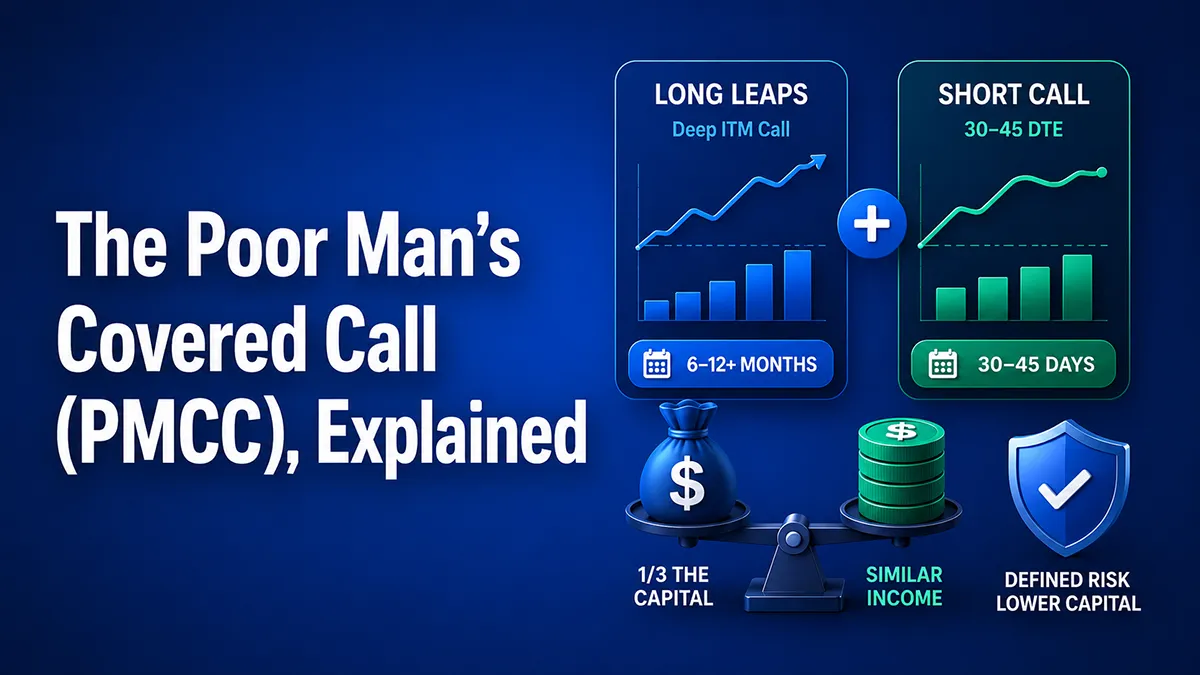
A poor man's covered call (PMCC) is a diagonal spread that mimics a covered call for far less capital: instead of buying 100 shares, you buy a deep in-the-money LEAPS call as a stock substitute and sell shorter-dated out-of-the-money calls against it. It typically ties up only about 30-50% of the capital a share-backed covered call requires. The trade-off is that the long LEAPS decays and expires, so PMCCs need steadily uptrending stocks, careful strike selection (a LEAPS around 0.80+ delta, short calls near 0.20-0.30 delta), and active management of both legs.
Track your covered call & cash-secured put income with ledger-grade P&L in CoverEdge — free 14-day Pro trial, no card.
Start free trialThe poor man's covered call (PMCC) — formally a diagonal call debit spread — is what you trade when you want covered call income but don't have $30,000+ to buy 100 shares of a quality name. Instead of owning the stock, you own a deep-in-the-money LEAPS call as a stock substitute, then sell shorter-dated calls against it. Same income mechanic, often 1/3 the capital. This guide covers the setup, the math, the risks, and when a PMCC beats a true covered call.
Try the math on a real ticker — for free
Plug in any of 200+ tickers and get live premium, annualized yield, breakeven, and assignment P&L instantly. No signup, no credit card.
What Is a Poor Man's Covered Call?
A PMCC is a diagonal spread with two legs:
- Long leg (the "stock substitute"): Buy a deep-ITM call with at least 6–12 months to expiration (a LEAPS). Delta should be 0.80 or higher so it tracks the stock nearly 1:1.
- Short leg (the "covered call"): Sell a 30–45 DTE out-of-the-money call against the LEAPS, exactly like you'd sell a regular covered call.
The LEAPS gives you long exposure with much less capital. The short call generates the income. Roll the short call monthly, hold the LEAPS until it has 4–5 months left, then roll the LEAPS too.
PMCC Example with Real Numbers
Stock: MSFT at $420. A real covered call would require 100 shares = $42,000 in capital. Instead:
- Buy the Jan 2027 $320 call (LEAPS). Delta ~0.85, premium ~$112. Cost: $11,200. You now control 100 shares with $11,200 of capital instead of $42,000 — 73% less capital.
- Sell the 30 DTE $440 call. Premium ~$4.50, so $450 collected.
Three possible outcomes 30 days later:
- MSFT stays at $420: Short call expires worthless. Keep $450. Your LEAPS still has 11 months of life. Annualized return on the $11,200 capital: ~48%.
- MSFT rises to $445: Short call is ITM by $5. You either close it ($500 debit) for a $50 net loss on the short leg — offset by ~$2,100 of LEAPS appreciation — or roll up and out for additional credit. Net: profitable.
- MSFT drops to $400: Short call expires worthless. Keep $450. The LEAPS loses ~$1,700 of value. Net P&L: −$1,250 on the position. You still own a long-dated LEAPS to keep selling against.
PMCC vs Traditional Covered Call: Side-by-Side
| Factor | Covered Call (100 shares) | Poor Man's Covered Call |
|---|---|---|
| Capital required (MSFT example) | $42,000 | $11,200 |
| Dividends collected | Yes | No (LEAPS don't receive dividends) |
| Maximum loss | Stock to zero ($42,000) | LEAPS premium paid ($11,200) |
| Holding-period tax treatment | Can qualify for LT capital gains | Always short-term on the LEAPS roll |
| Theta decay risk | None on the stock | Yes — LEAPS loses extrinsic value over time |
| Roll mechanics | Short call only | Short call + periodic LEAPS roll |
Choosing the Right LEAPS
The LEAPS leg is the "stock substitute," so it needs to behave like stock. Three rules:
- Delta ≥ 0.80. Lower delta = more leverage but more theta decay. 0.80+ ensures the LEAPS moves nearly 1:1 with the underlying.
- DTE ≥ 6 months (12+ preferred). Longer-dated LEAPS have lower daily theta decay because their extrinsic value erodes more slowly.
- Bid/ask spread < 2%. Tight spreads matter because you'll close or roll the LEAPS eventually, and wide spreads eat your return.
The Short-Call Strike: Higher Than You Think
On a traditional covered call, strike selection balances premium vs assignment risk. On a PMCC, there's an extra rule: the short strike should be above the LEAPS strike + LEAPS premium paid. Otherwise, if the short call goes ITM and is assigned, you'd have to exercise the LEAPS at a lower strike than you sold — locking in a loss on the spread.
In the MSFT example: LEAPS strike $320 + premium $112 = $432 minimum. The $440 short strike is safely above. If you'd sold the $425 strike, an aggressive rally would force a loss on the diagonal.
Risks Specific to the PMCC
- LEAPS theta decay. Even at delta 0.85, your LEAPS loses 1–3% of value per month from time decay alone. You need the short-call premium to outpace this.
- Early assignment on the short leg. Around ex-dividend dates, deep-ITM short calls can be assigned. Without 100 shares to deliver, you'd need to buy them or exercise the LEAPS — usually for a loss.
- IV crush on the LEAPS. If implied volatility drops dramatically (e.g., after earnings), your long LEAPS loses extrinsic value even if the stock didn't move.
When a PMCC Beats a Traditional Covered Call
- Your account is under $50k and you want exposure to high-priced names like MSFT, GOOGL, AVGO, or BRK.B
- You don't care about dividends (or the underlying doesn't pay one)
- You want to bound your maximum loss in case of a major drawdown
- You're willing to actively manage two legs instead of one
Not sure which names suit a PMCC? See our ranked list of the best stocks for the poor man's covered call.
Tracking PMCCs in CoverEdge
PMCCs introduce a second leg (the LEAPS) that most options trackers either ignore or treat as a separate trade. CoverEdge tracks the LEAPS as a position with a true cost basis, the short call as a covered call against it, and the cumulative P&L across both legs through every roll — so you always know whether the spread as a whole is profitable, not just the latest short-call cycle.
Frequently asked questions
What is a poor man's covered call?
A poor man's covered call (PMCC) is a diagonal call spread that mimics a covered call using far less capital. Instead of buying 100 shares, you buy a deep in-the-money LEAPS call (a long-dated option that acts as a stock substitute) and sell shorter-dated out-of-the-money calls against it to collect premium — the same income mechanic as a covered call, at roughly one-third the capital outlay.
How much capital does a PMCC save versus a covered call?
It depends on the stock, but a PMCC typically ties up about 30–50% of the capital a traditional covered call requires. For a $200 stock, 100 shares cost $20,000, while a deep-ITM LEAPS might cost $6,000–$8,000. That capital efficiency is the main appeal — but it comes with added complexity and time decay on the long LEAPS.
What are the risks of a poor man's covered call?
The biggest risks are: the long LEAPS loses value if the stock falls (and unlike shares, it expires); your short call can be assigned, creating management complexity; and if the stock gaps above your short strike, you can face a loss if the LEAPS hasn't appreciated enough to cover it. PMCCs also require monitoring two legs and rolling the short call regularly.
What delta should the long LEAPS be for a PMCC?
Most PMCC traders buy a LEAPS with a delta around 0.80 or higher (deep in the money) so it tracks the stock closely and has minimal extrinsic value to decay. The short call is usually sold at a delta of roughly 0.20–0.30 (out of the money), the same range many covered call sellers target, to balance premium against assignment risk.
Track every premium dollar with CoverEdge
AI-enhanced research, assignment-aware roll analysis, and ledger-grade P&L that survives every roll, close, and assignment. Decision-support, not advice — you decide.
No credit card required · Cancel anytime