Covered Call Liquidity: Reading Spreads, Open Interest & Volume
Key takeaway
An option's quoted premium and the premium you can actually collect differ by its liquidity — how easily you can trade it at a fair price. Three numbers tell you whether a covered call or cash-secured put is genuinely tradeable. The bid-ask spread is the gap between the highest price a buyer will pay (bid) and the lowest a seller will accept (ask); as a share of the midpoint, under ~5% is liquid, 5–10% is usable with a limit order, 10–20% risks real slippage, and over ~20% is often not worth chasing. Open interest is the total contracts held open at that strike — 50–100+ is a common comfort floor. Volume is how many traded today, confirming a strike is currently active. Because premium selling means repeatedly selling to open and buying to close or roll, illiquid chains quietly tax every move, so favor tight spreads, high open interest, steady volume, and always use limit orders.
Track your covered call & cash-secured put income with ledger-grade P&L in CoverEdge — free 14-day Pro trial, no card.
Start free trialThe premium a screener shows you and the premium you can actually collect are not always the same number. The gap between them is liquidity — how easily you can open and close an option at a fair price. This guide explains the three numbers that tell you whether a covered call (or cash-secured put) is genuinely tradeable: the bid-ask spread, open interest, and volume. No advanced market-structure knowledge required — just enough to stop handing your premium back to the market on every trade.
Written for beginner-to-intermediate premium sellers. The thresholds below are practical rules of thumb, not hard rules — always check the live chain before you trade.
Try the math on a real ticker — for free
Plug in any of 200+ tickers and get live premium, annualized yield, breakeven, and assignment P&L instantly. No signup, no credit card.
First, What “Liquidity” Actually Means
An option is liquid when lots of people are buying and selling it, so you can get in and out quickly at a price close to its true value. It is illiquid when trading is thin — you may have to accept a worse price just to get filled, or wait and hope. For an income seller this matters twice: once when you sell the call to open, and again every time you buy it back to close or roll it. A liquid option costs you almost nothing to trade around; an illiquid one quietly taxes every move you make.
Number 1: The Bid-Ask Spread
Every option has two live prices. The bid is the highest price a buyer will pay right now. The ask (or offer) is the lowest price a seller will accept. The spread is the gap between them, and the midpoint (bid plus ask, divided by two) is the option's rough fair value.
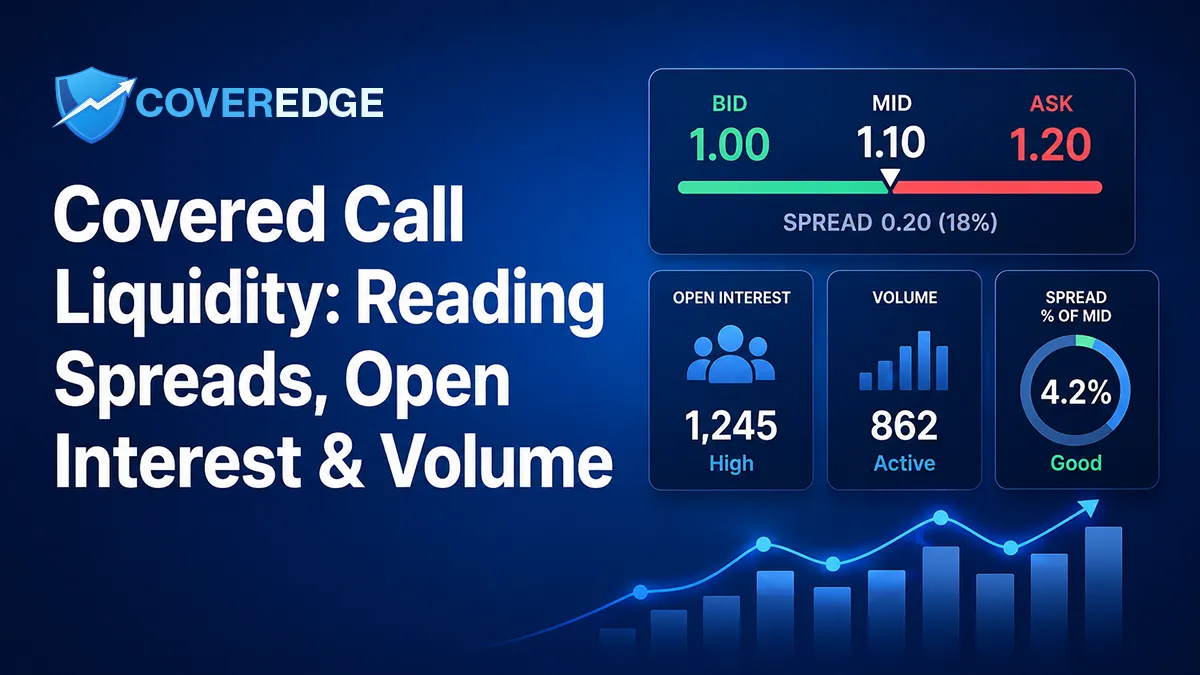
When you sell a covered call, you are the seller — so if you place a plain market order, you get filled at the bid, the lower number. Say a call shows a bid of $1.00 and an ask of $1.20. The midpoint is $1.10, but a market order fills you at $1.00. That missing $0.10 is $10 per contract handed straight to the market maker — before you have made a cent. When you later buy the call back to close, the spread bites again, this time on the ask side.
The absolute spread matters less than the spread relative to the premium. A $0.10 spread on a $3.00 option is trivial; the same $0.10 spread on a $0.40 option is a quarter of the whole premium. The useful measure is the spread as a percentage of the midpoint:
spread % = (ask − bid) ÷ midpoint × 100
Example: ask $1.20, bid $1.00 → spread $0.20, midpoint $1.10 → 0.20 ÷ 1.10 = ~18%. Almost a fifth of the premium is at risk to the spread.
A Rough Spread Guide (Percentage of Midpoint)
Rules of thumb, not laws. Use these to sort “fine” from “be careful” — always confirm on the live chain.
| Spread as % of midpoint | What it usually means |
|---|---|
| Under ~5% | Generally liquid — the most heavily traded names |
| ~5–10% | Usable, but always work a limit order near the midpoint |
| ~10–20% | Material slippage risk — the spread eats real premium |
| Over ~20% | Often not worth chasing — the market maker wins, not you |
Number 2: Open Interest
Open interest (OI) is the total number of that exact option contract — specific strike, specific expiration — currently held open across the whole market. Think of it as the size of the existing crowd already in that contract. High open interest means many participants are active at that strike, which usually comes with tighter spreads and easier fills.
For covered calls and cash-secured puts, a common comfort floor is at least 50–100 contracts of open interest at the strike you want, and more is better. Below that, you are often the only serious player at that strike, which is exactly when spreads widen and rolling gets expensive. Open interest is a slow-moving, stable signal — it is the best single check that a strike is not a ghost town.
Number 3: Volume
Volume is how many of that contract changed hands today. Where open interest is the standing crowd, volume is today's foot traffic. It resets to zero every morning, so early in the session it can look thin even on liquid names — which is why open interest is the steadier gauge.
Volume is still useful in two ways. Healthy daily volume confirms the strike is actively traded right now, and unusually high volume can flag news or an event worth understanding before you sell into it. The simplest read: use open interest to judge whether a strike is liquid at all, and use volume to confirm it is currently active.
Putting the Three Together
You rarely need to weigh these one at a time — in practice they move together. The most liquid options are the ones with a narrow spread, high open interest, and steady volume all at once. When one is off, the others usually confirm it. Here is the same option judged two ways:
| Signal | Liquid (trade it) | Illiquid (be careful) |
|---|---|---|
| Spread % of midpoint | Under ~5% | Over ~15–20% |
| Open interest at strike | Hundreds or thousands | Single digits to a few dozen |
| Daily volume | Regularly active | Zero or a handful |
Why This Hits Income Sellers Twice as Hard
A buy-and-hold options trader might cross a wide spread once and forget it. But premium selling is a repeat activity: you sell to open, then very often buy to close or roll before expiration — and rolling means closing one contract and opening another, crossing spreads on both legs. On an illiquid chain, those repeated crossings can quietly erase a meaningful slice of a whole year's premium. Choosing liquid strikes up front is one of the cheapest edges available to a covered call seller, and it costs nothing but attention.
Three Practical Habits
- Always use a limit order, never a market order. Start your limit at or just inside the midpoint and adjust. On liquid options you will often get filled near the mid; on illiquid ones the market order was going to hurt you anyway.
- Check open interest before you fall in love with a premium. A rich-looking credit on a strike with a dozen contracts of open interest is often a mirage you cannot exit cleanly.
- Favor the front-and-center names when you are learning. The largest, most heavily traded stocks and index ETFs have the deepest, tightest option chains — the friendliest place to build the habit of reading liquidity.
Liquidity Is Also About the Stock
An option chain is only as liquid as the stock underneath it. Heavily traded underlyings tend to have tight, deep chains at many strikes and expirations; thinly traded small caps often have wide spreads and sparse open interest even when the stock itself seems fine. This is why nearly every one of our best stocks for covered calls and cash-secured put guides lists options liquidity as a top screening criterion — not as an afterthought. It is worth separating a strike's premium from a stock's volatility, too: our study of 93 live covered call setups shows a fat premium is usually a volatility price, while liquidity is the separate question of whether you can actually capture that premium cleanly.
Find Liquid Setups Without Reading Every Chain
Checking spreads, open interest, and volume strike by strike is exactly the tedious work a screener should do for you. The free CoverEdge covered call screener and cash-secured put screener rank live setups across 200+ tickers and factor liquidity into what surfaces, so thin-chain mirages don't float to the top. To sanity-check a single trade, the free covered call calculator shows the live bid, ask, and premium for any ticker — so you can see the spread you would be crossing before you place the order. And once you understand whether a premium is rich for a good reason, it helps to read IV rank vs IV percentile alongside it.
Frequently asked questions
What is a good bid-ask spread for options?
Judge the spread relative to the option's price, not in absolute terms. As a percentage of the midpoint (bid plus ask divided by two), under about 5% is generally liquid, 5–10% is usable if you work a limit order near the midpoint, 10–20% carries material slippage risk, and over about 20% is often not worth trading because the market maker captures too much of your premium. A $0.10 spread is trivial on a $3.00 option but a quarter of a $0.40 option.
What's the difference between open interest and volume?
Open interest is the total number of that exact contract (specific strike and expiration) currently held open across the whole market — the standing crowd. Volume is how many of that contract changed hands today, and it resets to zero every morning. Use open interest to judge whether a strike is liquid at all (a common floor is 50–100+ contracts), and use volume to confirm the strike is currently active. Open interest is the steadier signal because volume looks thin early in the session even on liquid names.
Why does options liquidity matter for covered call sellers?
Premium selling is a repeat activity: you sell a call to open, then often buy it back to close or roll before expiration — and rolling crosses the bid-ask spread on both legs. On an illiquid chain, those repeated crossings can erase a meaningful slice of a whole year's premium. Liquid options let you enter and exit near fair value at almost no cost, so choosing liquid strikes up front is one of the cheapest edges a covered call seller has.
Should I use a market order or a limit order for options?
Use a limit order. A market order to sell a covered call fills you at the bid — the lower price — handing the difference to the market maker. Instead, start your limit at or just inside the midpoint and adjust from there. On liquid options you will often get filled near the midpoint; on illiquid ones a market order was going to give you a poor price anyway, so the limit order protects you either way.
Track every premium dollar with CoverEdge
AI-enhanced research, assignment-aware roll analysis, and ledger-grade P&L that survives every roll, close, and assignment. Decision-support, not advice — you decide.
No credit card required · Cancel anytime