When Should You Close a Covered Call Early? Profit Targets, DTE & Opportunity Cost
Key takeaway
Consider closing a covered call early when most of the opening credit is already earned and the small amount left no longer compensates you for the time, assignment risk, event risk, and exit friction you must keep to earn it. The popular "close at 50% profit" rule is a useful checkpoint, not a universal rule: compare the actual dollars remaining against DTE, moneyness, any earnings or ex-dividend date in the window, the bid-ask spread, fees, and whether you still want to sell the shares at the strike. Buying to close ends the option obligation but leaves your shares in place — gross option P&L equals the opening credit minus the buy-to-close debit, and the stock result must be evaluated separately.
Track your covered call & cash-secured put income with ledger-grade P&L in CoverEdge — free 14-day Pro trial, no card.
Start free trialYou do not have to hold a covered call until expiration. Buying it back early can make sense when most of the premium has already been earned and the small amount left is no longer worth the time, assignment risk, or attention it costs to keep. But the popular “close at 50% profit” rule is a checkpoint, not a law. The better question is always the same: how much can you still earn, how long will it take, and what risk must you keep to earn it?
This guide is educational, not a recommendation or a universal exit rule. Your stock thesis, taxes, transaction costs, and willingness to sell the shares all matter, and none of them fit inside a single percentage.
Try the math on a real ticker — for free
Plug in any of 200+ tickers and get live premium, annualized yield, breakeven, and assignment P&L instantly. No signup, no credit card.
What Closing a Covered Call Early Actually Does
A covered call starts when you sell to open a call against 100 shares and collect a credit. To close it early, you buy to close the same contract. The option obligation disappears, but your shares stay right where they were. You can then hold the shares uncovered, sell another call, or sell the stock as a separate decision.
Your gross option profit at the moment you close is simple:
option P&L = opening credit − buy-to-close debit
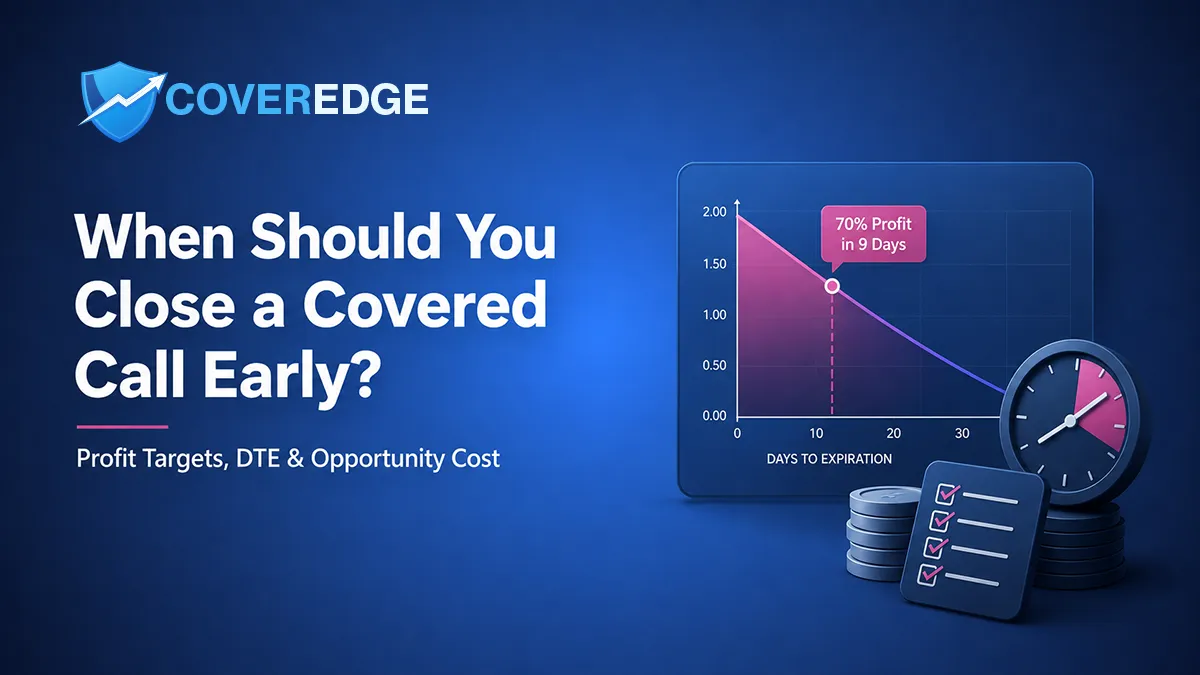
If you collected $2.00 ($200) and buy the call back for $0.60 ($60), the option leg has earned $140 before fees. You captured 70% of the original credit, and the most it can still earn is the remaining $60.
Keep the option result separate from the stock result. A call can show a loss because the stock rallied, while the combined covered position is still comfortably profitable. The accurate decision uses both legs together — the option, your share cost basis, and the outcome if the shares are called away. The free covered call calculator shows premium, breakeven, and “if assigned” P&L side by side before you ever open the trade.
The Most Useful Test: Remaining Reward vs. Remaining Risk
Suppose you sold a 30-day call for $2.00. Nine days later it trades near $0.60, with 21 days still on the clock. You have earned $140 — 70% of the maximum option profit — in less than a third of the planned holding period. Staying short for another three weeks can earn only $60 more, and you still carry the full obligation to sell the shares at the strike the whole time.
That does not automatically mean “close.” It means the trade has earned a fresh comparison. Ask whether $60 of remaining premium is fair pay for 21 more days of stock movement, any earnings or dividend event inside the window, expiration-week sensitivity, and the spread plus fees you will pay to exit. Framing the decision as remaining reward against remaining risk is far more durable than any fixed percentage target.
Four Reasons an Early Close May Make Sense
1. Most of the premium arrived much faster than expected
Time is one of the resources an income strategy spends. If a call loses 60–80% of its value in a few days, holding it for weeks to collect the last small piece may be an inefficient use of that time and of the capital the shares tie up. Closing removes the obligation and lets you reassess the stock deliberately — but a fast profit only helps if the next decision is disciplined too. Do not churn into a worse contract just to feel busy.
2. The event calendar changed
Earnings, an ex-dividend date, or major company news can change the risk that existed when you opened the call. A short call that looked routine can suddenly carry gap risk, and deep in-the-money calls carry higher early-assignment risk right before an ex-dividend date. Our guide to covered calls around earnings explains why the fatter premium near an event is payment for real risk, not free income.
3. Your reason for owning or selling the shares changed
Closing the call can restore unlimited upside in the shares, but that freedom has a price. If the stock has rallied and the call now costs $6.25 after you sold it for $2.00, buying it back realizes a $425 loss on the option leg before fees. The shares may have gained more than that, so this is not automatically a losing covered position — but it is an expensive way to reopen the upside, and it deserves a clear-eyed comparison against accepting assignment or rolling the covered call.
4. The final dollars are not worth the expiration risk
Near expiration, an option's delta can swing quickly when the stock sits close to the strike. Paying a few dollars to remove that uncertainty can be reasonable when keeping the shares matters to you. On the other hand, a wide bid-ask spread can make a cheap-looking exit surprisingly costly. Read the covered call liquidity guide and use a limit order instead of donating the spread with a market order.
How DTE Changes the Decision
DTE by itself is not an exit signal. It becomes useful only when you pair it with moneyness, the premium remaining, and your intended outcome. That is exactly why a proper expiration review tracks more than a date on a calendar.
Why “Close at 50% Profit” Is a Checkpoint, Not a Rule
Fifty percent is popular because it is simple and it forces a review before expiration. But two calls sitting at 50% profit can call for completely different decisions. One might have 35 DTE, an earnings report ahead, and a tight spread; the other might have 4 DTE, no event, and a $0.20-wide spread on a $0.25 option. The percentage captures none of that — not time, not liquidity, not your assignment preference.
Use a target to trigger a review, then compare the actual dollars left with the actual risk left. Closing solely to protect a perfect win rate can mislead you, too: one expensive exit can swamp many small winners, which is why net P&L belongs right next to win rate in your options trading scorecard.
When Holding May Be the Cleaner Choice
- You are comfortable selling the shares at the strike. Assignment may be the planned, profitable outcome — not something to spend money avoiding.
- The remaining premium still pays you for the time and risk. A fixed profit target should not override a plan that is still working.
- The exit friction is too large. A wide spread and fees can consume much of the small amount you are trying to protect.
- You have no better use for the reopened flexibility. Closing and immediately selling another mediocre call adds activity, not necessarily value.
If the option is in the money and assignment is acceptable, compare the full called-away result before paying a large debit to escape it. The covered call assignment guide walks through the stock gain, premium, and opportunity cost together.
Closing vs. Rolling: Do Not Blend the Two Decisions
A close ends the option position. A roll closes the current call and opens another call in one two-legged order. Your broker shows a roll as a single ticket, but economically it still contains a realized buy-to-close debit and a brand-new sell-to-open credit. Judge the old contract on its own first, then decide whether the new contract stands on its own merits.
If you do roll, track the cumulative result across the entire chain rather than treating each new credit as a fresh win. The article on tracking rolled options shows why the original premium, every close debit, every new credit, the fees, and the final outcome all have to stay connected.
A Five-Question Early-Close Checklist
- How many dollars — and what percentage of the opening credit — have I already earned?
- How many dollars remain, and how many days must I stay obligated to earn them?
- Where is the stock relative to the strike and to my share cost basis?
- Is an earnings date, ex-dividend date, or other known event inside the window?
- After the spread and fees, what will I actually do with the reopened shares?
Write the answers down before you place the order. When the close fills, record the actual debit and fees — not the midpoint you hoped to get. A ledger-first tracker keeps the opening credit and the closing cost tied to the same trade, so your net option P&L stays accurate whether the next step is to hold, roll, expire, or accept assignment. That accurate record is what turns a one-off “should I close this?” into a strategy you can actually measure and improve.
Frequently asked questions
When should you close a covered call early?
Consider closing early when most of the opening credit is already earned and the premium still left no longer pays you enough for the time and risk you must keep. A common trigger is capturing a large share of the credit well before expiration — for example, 70% of a $2.00 credit in nine days with 21 days still to go. That is a signal to review, not an automatic exit: compare the dollars remaining against DTE, moneyness, any earnings or ex-dividend event, the spread, and fees before deciding.
Should I always close a covered call at 50% profit?
No. The 50% profit target is a helpful checkpoint that forces a review before expiration, but it is not a universal rule. Two calls both at 50% profit can call for opposite decisions — one with 35 DTE and an earnings report ahead, another with 4 DTE, no event, and a wide spread. Use the target to trigger a review, then decide based on the actual dollars left, the time and risk remaining, liquidity, and whether you are happy to be assigned.
What happens when you buy to close a covered call?
Buying to close cancels the call obligation, so the option leaves your account while your 100 shares stay put. Your gross option profit is the opening credit minus the buy-to-close debit, before fees — collect $2.00 and buy it back for $0.60 and the option earned $140. You can then hold the shares uncovered, sell another call, or sell the stock as a separate decision. Keep the option result separate from the stock result, since a call can show a loss while the whole covered position is still profitable.
Is it better to close a covered call or roll it?
They answer different questions. Closing simply ends the position. Rolling closes the current call and opens a new one in a single order — economically a buy-to-close debit plus a new sell-to-open credit. Evaluate the existing call on its own first; then decide whether the new contract is worth opening on its own merits. If you roll, track the cumulative result across the whole chain rather than treating each new credit as a fresh win.
Track every premium dollar with CoverEdge
AI-enhanced research, assignment-aware roll analysis, and ledger-grade P&L that survives every roll, close, and assignment. Decision-support, not advice — you decide.
No credit card required · Cancel anytime