How to Track Rolled Options Positions (Without Losing Your P&L)
Key takeaway
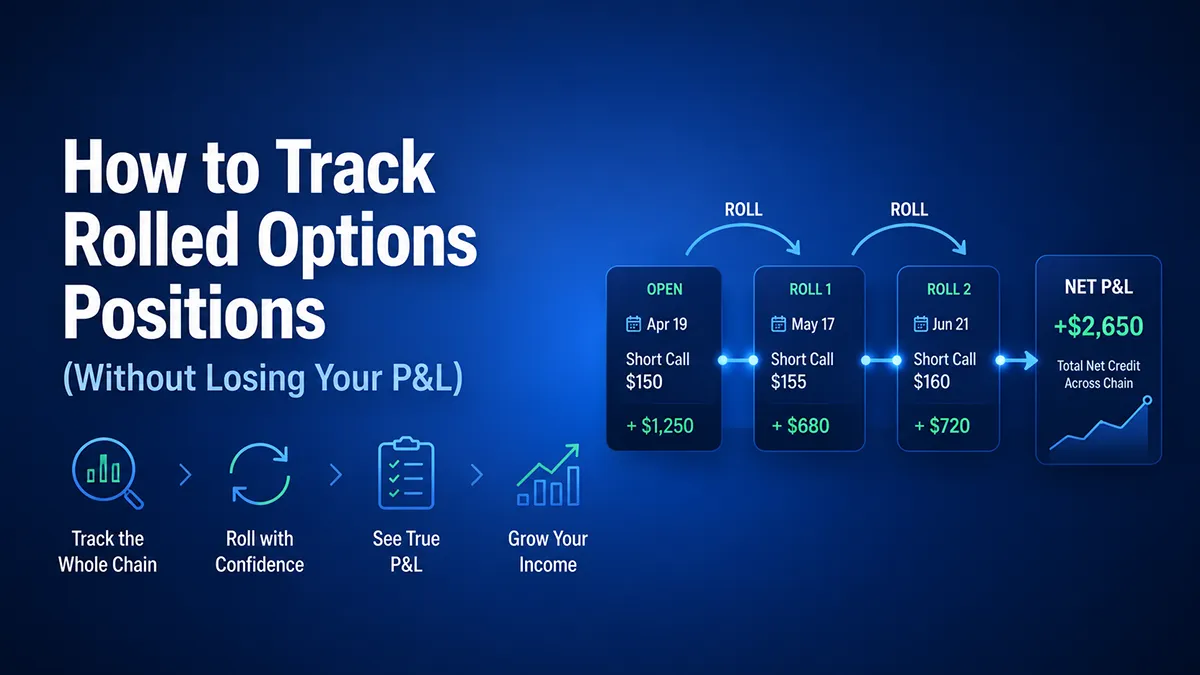
A rolled options position isn't one trade — it's a roll chain: the original open plus every roll (each a buy-to-close debit and a sell-to-open credit) through to the final expiration, close, or assignment. To keep the P&L accurate you must track the whole chain as one unit, not each transaction in isolation — specifically the cumulative net credit across all rolls, the true cost basis it produces on covered calls, the original vs. current strike and expiration, and the final realized P&L when the chain resolves. Spreadsheets drift because the links between rolled contracts live in hand-maintained formulas; a ledger-first tracker derives P&L from immutable entries so it stays correct no matter how many times you roll.
Track your covered call & cash-secured put income with ledger-grade P&L in CoverEdge — free 14-day Pro trial, no card.
Start free trialRolling is the move that keeps an income position alive — buy back the option you sold and sell a new one further out in time, often at a better strike. It's powerful, but it's also the exact moment most traders lose the thread on their real profit and loss. One rolled position is really a chain of trades, and unless you track the whole chain as a single unit, your P&L slowly drifts away from the truth. Here's how to track rolled options positions so the numbers still add up after the fifth, tenth, or twentieth roll.
Try the math on a real ticker — for free
Plug in any of 200+ tickers and get live premium, annualized yield, breakeven, and assignment P&L instantly. No signup, no credit card.
Why Rolled Positions Are So Easy to Mistrack
When you roll a covered call or a cash-secured put, two things happen in the same instant: you buy to close the existing short option (usually at a debit) and you sell to open a new one (a credit). Your broker records these as two separate line items, sometimes netted into a single "roll" ticket, sometimes not. Do that five times and a single logical position has produced ten or more transactions scattered across your trade history.
The problem is that none of those individual rows tells you what you actually want to know: across this entire position, from the day I first sold the option to today, am I net ahead — and by how much? That answer lives in the chain, not in any single trade.
What a "Roll Chain" Actually Is
A roll chain is the full sequence of linked trades that make up one continuously-managed position. Think of it as one story told in chapters:
- Chapter 1 — the open. You sell the first call or put and collect a premium. This is the start of the chain.
- Chapters 2–N — the rolls. Each roll closes the prior contract (a debit) and opens the next (a credit). The net of those two legs is what matters, and it can be positive or negative on any given roll.
- The final chapter — the resolution. The chain ends when the last option expires worthless, is bought back to close, or is assigned. Only then is the position's total realized P&L final.
Track each row in isolation and you'll see a confusing mix of credits and debits. Track the chain and you see one clean number: total net premium collected across the life of the position.
The Four Numbers You Must Track Across a Chain
Whether you use a spreadsheet, a notebook, or dedicated software, these are the four figures that keep a rolled position honest:
- Cumulative net credit. Sum every premium you collected and subtract every debit you paid to buy contracts back — across the whole chain. This is your true income from the position so far, and it's the number a per-trade view can never show you.
- True cost basis (for covered calls). If you own the underlying shares, every net credit from the chain lowers your effective cost basis. Miss a single roll and your breakeven — and any eventual assignment P&L — is wrong.
- Original vs. current strike and expiration. Rolling up, down, and out changes both. You need to know where the position started and where it stands now to judge whether you're still being paid to hold the risk.
- Realized-on-resolution. When the chain finally closes, expires, or assigns, you need the position's final realized P&L to roll cleanly into your records — and, at tax time, onto Form 8949.
Why Spreadsheets Break on the Third Roll
A spreadsheet handles your first roll fine: two new rows, a quick formula. The trouble starts when you have to keep those rows linked. There's no native concept of "this contract replaced that one," so the connection lives entirely in formulas you maintain by hand. After a few rolls it becomes formula spaghetti — one fat-fingered cell, one double-counted premium, one forgotten buy-to-close debit, and your cumulative net credit is quietly wrong. It still looks right, which is the dangerous part.
We wrote a whole piece on where this leads — covered call tracker vs spreadsheet — but rolling is the single fastest way to outgrow a sheet.
How CoverEdge Tracks Rolled Positions Automatically
CoverEdge is built ledger-first, which means every premium, every buy-to-close, and every assignment is recorded as an immutable entry — and your P&L is always derived from those entries, never typed in by hand. That design is what makes roll tracking automatic:
- Rolls link automatically. When you roll a trade, CoverEdge closes the old contract and opens the new one as a connected chain, so the position keeps its full history instead of fragmenting into loose rows.
- Cumulative net P&L is always live. The chain shows the running total of every credit and debit across all rolls, so you always know whether the position is net ahead.
- Cost basis recalculates itself. For covered calls on shares you own, each net credit flows into your position's cost basis automatically — and if the chain ends in assignment, the realized P&L already accounts for every premium collected.
- Roll planning built in. Pro users get roll recommendations and an expiration review workflow, so rolling is a deliberate decision rather than a scramble on expiration Friday.
A Simple Rule of Thumb
If you roll positions more than a couple of times a year, track the chain, not the trade. The individual rows will always look noisy; the chain is where your real income lives. For the strategy side of the decision — when a roll makes sense and when to just take assignment — see our guide to rolling covered calls. And to make sure the premium from every chain lands in a clean, tax-ready record, see how to track options premium income. Rolling inside a full put-to-call cycle adds another layer — the wheel strategy tracker guide covers tracking rolls across the whole wheel.
Frequently asked questions
What does it mean to track a roll chain?
Tracking a roll chain means treating a position that's been rolled multiple times as one linked sequence of trades rather than a pile of separate transactions. You follow the position from its first open, through every roll (each a buy-to-close plus a sell-to-open), to its final expiration, close, or assignment — keeping a running total of the net premium collected across the entire chain.
Why is my rolled options P&L wrong in my spreadsheet?
Almost always because a leg went uncounted or a link broke. Each roll adds a debit (buy-to-close) and a credit (sell-to-open) that have to be tied back to the original position by hand. Miss one debit, double-count one premium, or overwrite one formula, and the cumulative total silently drifts. A ledger-first tracker avoids this by deriving P&L from immutable entries instead of manual formulas.
Does rolling an option reset my cost basis?
Rolling the option doesn't reset the holding period on your underlying shares, but each net credit from the chain does lower your effective cost basis on a covered call. That's why tracking the whole chain matters — your true breakeven reflects every premium collected across all the rolls, not just the most recent one. The tax treatment of the option legs is separate; confirm specifics with a tax professional.
Can CoverEdge track positions I've rolled many times?
Yes — roll-chain tracking is one of the core reasons CoverEdge exists. It links every roll into a single position, keeps a live cumulative net P&L across the whole chain, recalculates cost basis through assignments automatically, and preserves the full history — the part that breaks most spreadsheets after a handful of rolls.
Track every premium dollar with CoverEdge
AI-enhanced research, assignment-aware roll analysis, and ledger-grade P&L that survives every roll, close, and assignment. Decision-support, not advice — you decide.
No credit card required · Cancel anytime