How to Track Options Expiration Dates (Never Miss One)
Key takeaway
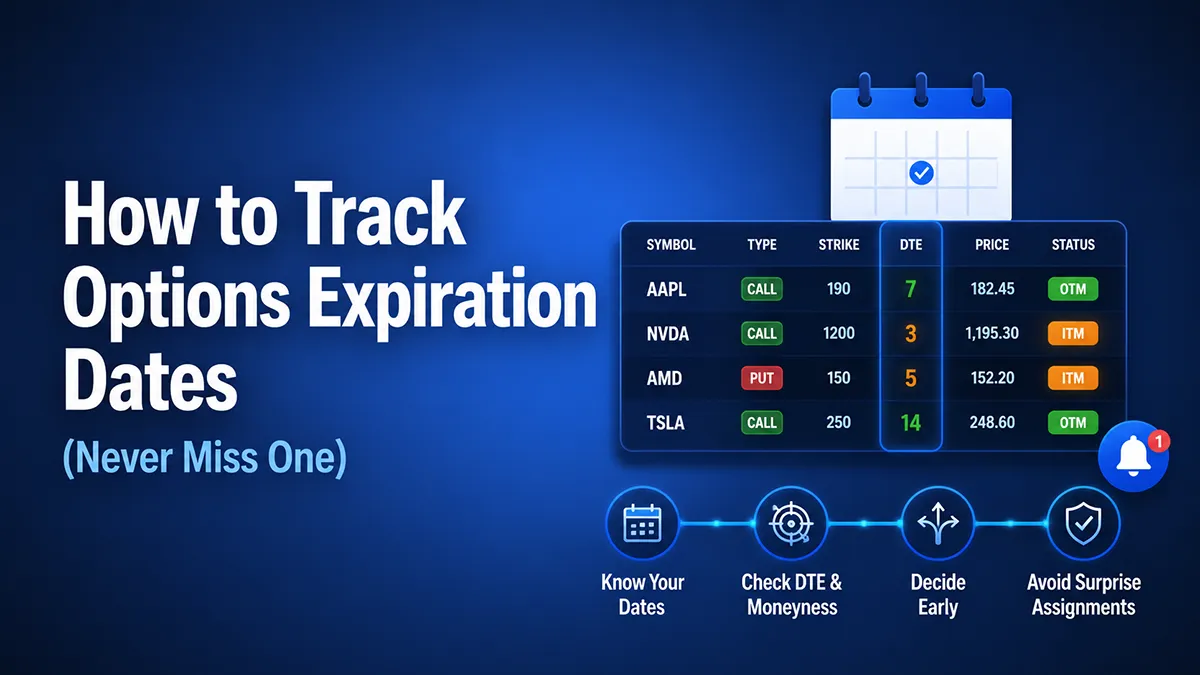
To never miss an options expiration, track four things for every open position rather than just the date: days to expiration (DTE), moneyness (where the strike sits relative to the stock), assignment risk (in-the-money positions near expiration, and short calls heading into an ex-dividend date), and the action you intend to take — let it expire, close early, or roll. The reliable habit is a short weekly review: sort open positions by DTE, look at anything expiring in the next 7-10 days, check moneyness, and decide in advance. A phone calendar tells you a date arrived but not whether the option is in the money; a ledger-first tracker shows live DTE and moneyness on every position so the decision is made on your terms, not the market's.
Track your covered call & cash-secured put income with ledger-grade P&L in CoverEdge — free 14-day Pro trial, no card.
Start free trialEvery short option you sell has a deadline, and the week it expires is the week it needs your attention most. Miss it and you don't just lose track of a position — you can wake up to shares called away, a stock put to you overnight, or a cash-settled surprise you never chose. The good news: never missing an expiration is a solvable problem. Here's how to track options expiration dates so no position ever ages out without a decision.
Try the math on a real ticker — for free
Plug in any of 200+ tickers and get live premium, annualized yield, breakeven, and assignment P&L instantly. No signup, no credit card.
Why Missed Expirations Are So Costly
An expiring option isn't a passive event — it forces one of three outcomes. If your short call or put is out of the money, it expires worthless and you keep the full premium (good, but you also want to have the next trade ready). If it's in the money, it gets assigned: your shares are called away on a covered call, or 100 shares per contract are put to you on a cash-secured put. And if you simply forget the position exists, the market decides for you.
The cost of a missed expiration is rarely the premium itself — it's the unplanned outcome. Unexpected assignment can trigger a taxable sale you didn't intend, tie up capital you needed elsewhere, or leave you holding a stock through a gap you would have rolled away from. See our guide to covered call assignment for exactly what happens when a position finishes in the money.
The Expiration Data You Actually Need to See
Tracking expirations well isn't about staring at a calendar — it's about surfacing the right four facts for every open position, at a glance:
- Days to expiration (DTE). The single most important number. It tells you how much time value is left to decay and how soon you need to act. Most premium sellers start paying close attention inside 21 DTE and make a decision by expiration week.
- Moneyness — where the strike sits vs. the stock. An option 10% out of the money at 2 DTE is a very different situation than one sitting right at the strike. This is what tells you whether assignment is likely.
- Assignment risk flags. In-the-money positions approaching expiration — and any short call heading into an ex-dividend date — deserve a flag, because that's when early assignment is most likely.
- The action you intend to take. Let it expire, close early, or roll? Deciding before expiration week is the whole point of tracking dates in the first place.
Why Calendars and Broker Alerts Fall Short
The instinct is to drop each expiration into a phone calendar. It works until it doesn't: a calendar reminder tells you a date arrived, but not whether the option is in the money, what your net credit is across any rolls, or what you decided to do. It's a nag, not a decision surface.
Broker alerts have the opposite problem — they usually fire only after assignment has already happened, and they treat each contract in isolation. Neither approach gives you the one thing you want on a Monday morning: a single sorted list of everything expiring this week, ranked by how much it needs your attention. Spreadsheets can approximate this, but you have to update every DTE and moneyness cell by hand — and as we cover in covered call tracker vs spreadsheet, that maintenance is exactly what breaks down once you're juggling more than a handful of positions.
How CoverEdge Keeps Every Expiration in View
CoverEdge is built so an expiration never sneaks up on you. Because every position is tracked with a live quote and its full lifecycle, the platform can show you what matters and when:
- Every open position shows live DTE and moneyness. You always know how much time is left and whether a strike is in or out of the money — no manual updating.
- An expiration review workflow. Positions approaching expiration are gathered into one place so you can process the week deliberately — let winners expire, close early, or roll — instead of scrambling on Friday afternoon.
- Roll recommendations built in. When a position is worth extending, Pro users get data-driven roll suggestions right where the decision happens, so acting before expiration is a click, not a research project.
- Assignments flow into the ledger cleanly. If a position does get assigned, CoverEdge records it as an immutable entry and recalculates your cost basis automatically — so even an assignment you took on purpose stays perfectly accounted for.
A Simple Routine That Never Misses One
The traders who never get surprised all do roughly the same thing: they run a short weekly review. Once a week, sort your open positions by DTE, look at anything expiring in the next seven to ten days, check moneyness, and decide in advance — expire, close, or roll — for each one. That's it. The discipline isn't watching the market all day; it's making the decision early, on your terms.
Once every expiration lands in a clean record, the same data powers the rest of your tracking — including how to track options premium income across your whole portfolio. Never missing an expiration is really just the first habit of keeping an accurate options ledger.
Frequently asked questions
How do I make sure I never miss an options expiration?
Run a short weekly review instead of relying on memory. Once a week, sort your open positions by days to expiration, look at anything expiring in the next 7-10 days, check whether each is in or out of the money, and decide in advance whether to let it expire, close it early, or roll it. Deciding before expiration week — rather than reacting on Friday afternoon — is what keeps you from being surprised.
What happens if I forget about an option that expires in the money?
It gets assigned automatically. On a covered call, your 100 shares per contract are called away at the strike; on a cash-secured put, 100 shares are put to you. That's not inherently bad if you intended it, but an unplanned assignment can trigger a taxable sale you didn't want, tie up capital, or leave you holding a stock through a move you'd have rolled away from. The cost is usually the unplanned outcome, not the premium.
Aren't broker alerts and a calendar enough to track expirations?
They help, but they fall short. A calendar reminder tells you a date arrived, not whether the option is in the money or what you decided to do. Broker alerts often fire only after assignment has already happened and treat each contract in isolation. What you actually want is a single sorted list of everything expiring this week, ranked by how much attention it needs — which is what a dedicated tracker provides.
How does CoverEdge help me track expiration dates?
CoverEdge shows live days-to-expiration and moneyness on every open position, and gathers positions approaching expiration into an expiration review workflow so you can process the week deliberately. Pro users get built-in roll recommendations right where the decision happens, and if a position is assigned, CoverEdge records it as an immutable ledger entry and recalculates your cost basis automatically.
Track every premium dollar with CoverEdge
AI-enhanced research, assignment-aware roll analysis, and ledger-grade P&L that survives every roll, close, and assignment. Decision-support, not advice — you decide.
No credit card required · Cancel anytime