Real-Time Options Tracking: What Actually Needs to Be Live?
Key takeaway
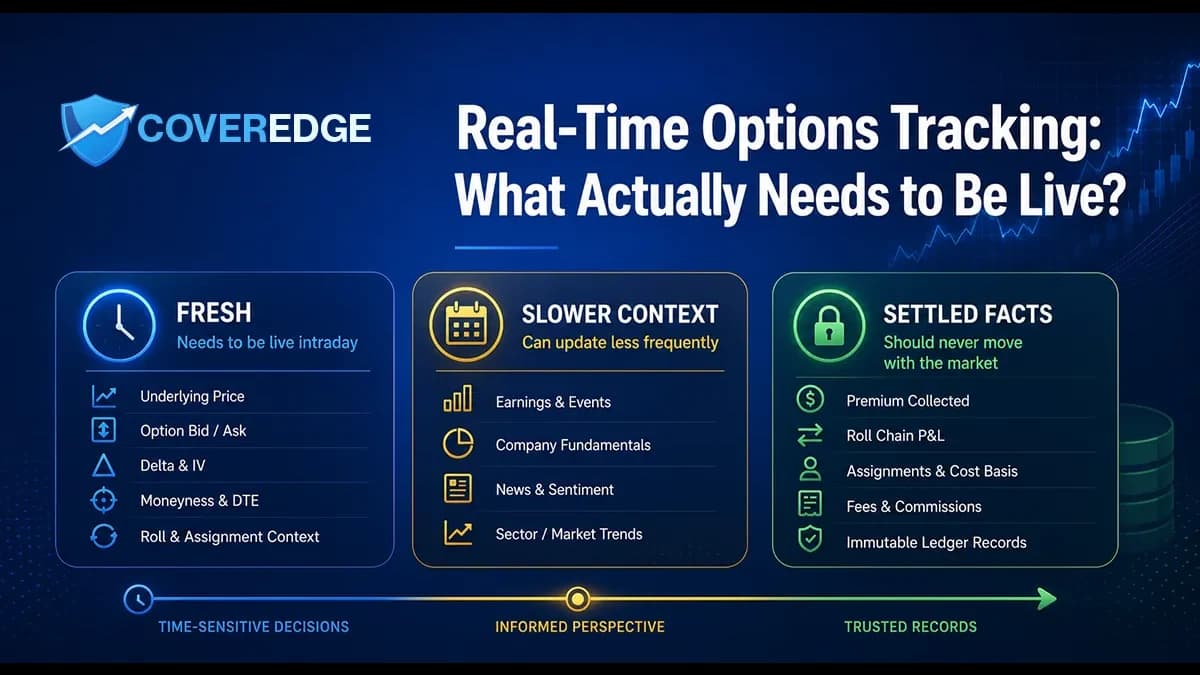
"Real-time" hides three different kinds of data, and only one needs to be live. For covered call and cash-secured put sellers, the fields that must be fresh intraday are the underlying price, option bid/ask, delta/IV, and moneyness/DTE — but 'fresh' means current within a few minutes, not streamed every fraction of a second, because a multi-week income position doesn't become a different decision on a one-penny tick. Slower-moving context (earnings, fundamentals, sentiment) can update daily. And your trade records — premium collected, roll-chain P&L, assignments, fees, and cost basis — are settled facts that should never be recomputed from a moving quote; a ledger-first tracker keeps them immutable. When markets are closed, an honest tool serves a clearly-marked closing snapshot rather than relabeling unchanged prices as 'live.' Match the data to the decision: only the moment you actually place a roll or buy-to-close wants 'as of this second' pricing, and you confirm that fill at your broker anyway.
Track your covered call & cash-secured put income with ledger-grade P&L in CoverEdge — free 14-day Pro trial, no card.
Start free trial“Is it real-time?” is the first question people ask about any options tracker — and it’s the wrong first question. A trading terminal and a portfolio tracker solve different problems, and for covered calls and cash-secured puts, almost nothing in your account actually needs to update tick-by-tick. What you need is the right data refreshed at the cadence of the decision you’re making. Here’s how to tell which numbers must be live, which can lag, and which should never move with the market at all.
Try the math on a real ticker — for free
Plug in any of 200+ tickers and get live premium, annualized yield, breakeven, and assignment P&L instantly. No signup, no credit card.
“Real-Time” Is Not One Thing
The phrase gets used as if it describes a single feature, but three very different kinds of data hide behind it:
- Streaming market data — the underlying stock quote and the option bid/ask that tick throughout the session. This is what a day trader watches on a Level 2 screen.
- Derived analytics — delta, implied volatility, moneyness, days to expiration. These move with the quote but far more slowly, and small changes rarely change your decision.
- Your trade records — the premium you collected, the strike you sold, your roll chain, your assignments, your cost basis. These are facts about the past and shouldn’t change at all when the market moves.
Lumping all three under “real-time” is how people end up paying for a streaming terminal to do a job a ledger does better. Separate them and the requirements get clear.
The Data That Genuinely Needs to Be Fresh Intraday
For an income seller, a short list of fields is time-sensitive because they feed a decision you might make today:
- The underlying price — how close is the stock to your strike right now?
- The option bid/ask — what would it cost to buy back or roll this position at this moment?
- Delta and implied volatility — has assignment risk or premium richness shifted enough to act on?
- Moneyness and DTE — is this position in the money heading into expiration week?
- Roll and assignment context — the live numbers behind a roll decision or an approaching assignment.
Notice what these have in common: they matter when you’re actively evaluating a trade. “Fresh” here means current enough that the number you see is the number you’d act on — refreshed every few minutes, not streamed every 50 milliseconds. A covered call you’re holding for three weeks does not become a different decision because the quote moved a penny between one glance and the next.
The Records That Should Never Move With the Market
This is the half of “tracking” that streaming data has nothing to do with — and the half most spreadsheets and quote-first apps get wrong. Once a trade happens, these are settled facts:
- Premium collected on every position you’ve opened.
- Buy-to-close debits and roll legs — what you paid to exit or extend.
- Cumulative roll-chain P&L — eight rolls are one economic story, not eight (see how to track rolled options).
- Assignments and their cost-basis impact.
- Fees and commissions on every leg.
A live quote should never rewrite any of these. If your “tracker” recalculates last month’s realized income every time a price ticks, it isn’t tracking — it’s guessing. This is exactly why CoverEdge is ledger-first: your income, cost basis, and realized P&L are derived from an immutable record of what actually happened, not re-estimated from a moving quote. For the full field list, see what to track for every options trade.
Why Option Chains Don’t Need Tick-by-Tick Updates
Chain data — every strike’s bid, ask, IV, and delta — is expensive to stream and, for income decisions, mostly unnecessary at high frequency. When you’re choosing a strike to sell 30–45 days out, or deciding whether to roll a position that expires Friday, a chain refreshed every several minutes tells you everything a tick-by-tick feed would. The strike that’s attractive at 10:00 is still attractive at 10:08; the delta you’re targeting hasn’t meaningfully moved.
The place tick-level data matters is fast, in-and-out directional trading — a different game from selling premium against a position you already intend to hold. Paying for (and staring at) a streaming terminal to run a monthly covered call is optimizing the wrong variable.
After the Bell, on Weekends, and on Holidays
Here’s a subtlety most tools ignore: when the market is closed, prices aren’t changing, so a “live” label is theater. The honest thing to show is the closing snapshot — the last real prices — clearly marked, until the next open. Re-pinging a data provider every few minutes on a Saturday to redisplay Friday’s close burns money and tells you nothing new.
CoverEdge leans into this deliberately. During the regular session, quotes are refreshed on a roughly two-minute cadence and chains about every ten minutes, with short freshness windows so a stuck feed falls back to a live pull the next time you load a page. Once the market closes, it serves the closing snapshot for the rest of the day and over the weekend instead of pretending unchanged data is live. The whole thing is anchored to the exchange’s own clock — NYSE holidays, half-days, and daylight-saving shifts included — so “open” always means genuinely open. The live market-session indicator in the app header reflects exactly that state, counting down to the close and turning amber in the final 30 minutes.
Match the Data to the Decision
The useful way to think about “real-time” is per task. Each decision has its own natural refresh cadence:
| What you’re doing | What has to be current | Natural cadence |
|---|---|---|
| Screening for a new setup | Ranked yield, IV, probability of expiring OTM | Every several minutes |
| Picking a strike | Chain bid/ask, delta, breakeven | Every several minutes |
| Monitoring an open position | Underlying price, moneyness, DTE | A few times a day |
| Deciding to roll or close | Live cost-to-close, new-strike credit | At the moment you act |
| Reviewing performance | Net premium, ROC, roll-chain P&L | Never changes — it’s a ledger fact |
Only one row in that table wants “as of this second” data — the moment you actually place a roll or buy-to-close — and for that you confirm the fill at your broker anyway. Everything else is either “fresh within a few minutes” or “a settled fact.”
How to Judge a Tracker’s “Real-Time” Claim
Before you trust — or pay for — a tool’s live-data promise, ask five things:
- Where does the data come from, and is it a real market-data provider or a scraped delayed feed?
- Does it show a timestamp so you know how fresh a number actually is?
- Does it disclose delayed state honestly instead of labeling everything “live”?
- Is it market-session aware — does it know the difference between a moving market and a closed one?
- Is your trade history immutable, or does it get recomputed from live quotes (the tell of a tool that confuses tracking with quoting)?
A tool that answers those well is far more useful to an income seller than one that simply streams the fastest quote.
How CoverEdge Draws the Line
CoverEdge is built around this exact distinction. The free covered call calculator and screener pull fresh option-chain quotes on a few-minute cadence during market hours and mark data as delayed when it isn’t live — no pretending. Inside the app, your positions show live moneyness and DTE, the expiration review surfaces what needs a decision this week, and roll context is current at the moment you act. But your premium income, cost basis, and performance metrics come from an immutable ledger — so a moving quote updates what you might do next without ever rewriting what you’ve done. That’s the whole point: you don’t need everything to be live — you need the right things fresh and the rest to be true.
Frequently asked questions
Do I need a real-time options tracker for covered calls?
For selling covered calls and cash-secured puts, no — you don't need tick-by-tick streaming. What matters is that the underlying price, option bid/ask, delta, implied volatility, and moneyness are current within a few minutes when you're evaluating a trade. A multi-week income position doesn't change because the quote moved a penny between glances. Tick-level streaming matters for fast in-and-out directional trading, which is a different activity from selling premium against a position you already intend to hold.
What options data actually needs to be real-time?
The time-sensitive fields are the ones feeding a decision you might make today: the underlying stock price (how close is it to your strike?), the option bid/ask (what would it cost to buy back or roll now?), delta and implied volatility (has assignment risk or premium richness shifted?), and moneyness plus days-to-expiration heading into expiration week. Slower-moving context — earnings dates, fundamentals, sentiment, and historical volatility — can update once a day without affecting the quality of your decisions.
Should my trade history update with live prices?
No. Premium collected, buy-to-close debits, roll-chain P&L, assignments, fees, and cost basis are settled facts about the past — they should never be recomputed from a moving quote. A tracker that re-estimates last month's realized income every time a price ticks isn't tracking, it's guessing. This is why CoverEdge is ledger-first: your income and cost basis are derived from an immutable record of what actually happened, so a live quote can update what you might do next without ever rewriting what you've already done.
How does CoverEdge handle market data freshness?
During the regular U.S. session, CoverEdge refreshes underlying quotes on roughly a two-minute cadence and option chains about every ten minutes, with short freshness windows so a stuck feed falls back to a live pull on your next page load. When the market is closed, it serves the last closing snapshot for the rest of the day and over the weekend instead of pretending unchanged prices are live, and it marks data as delayed when it isn't current. Everything is anchored to the exchange clock — NYSE holidays, half-days, and daylight-saving shifts included — so 'open' always means genuinely open.
Track every premium dollar with CoverEdge
AI-enhanced research, assignment-aware roll analysis, and ledger-grade P&L that survives every roll, close, and assignment. Decision-support, not advice — you decide.
No credit card required · Cancel anytime