What Information Should You Track for Every Options Trade?
Key takeaway
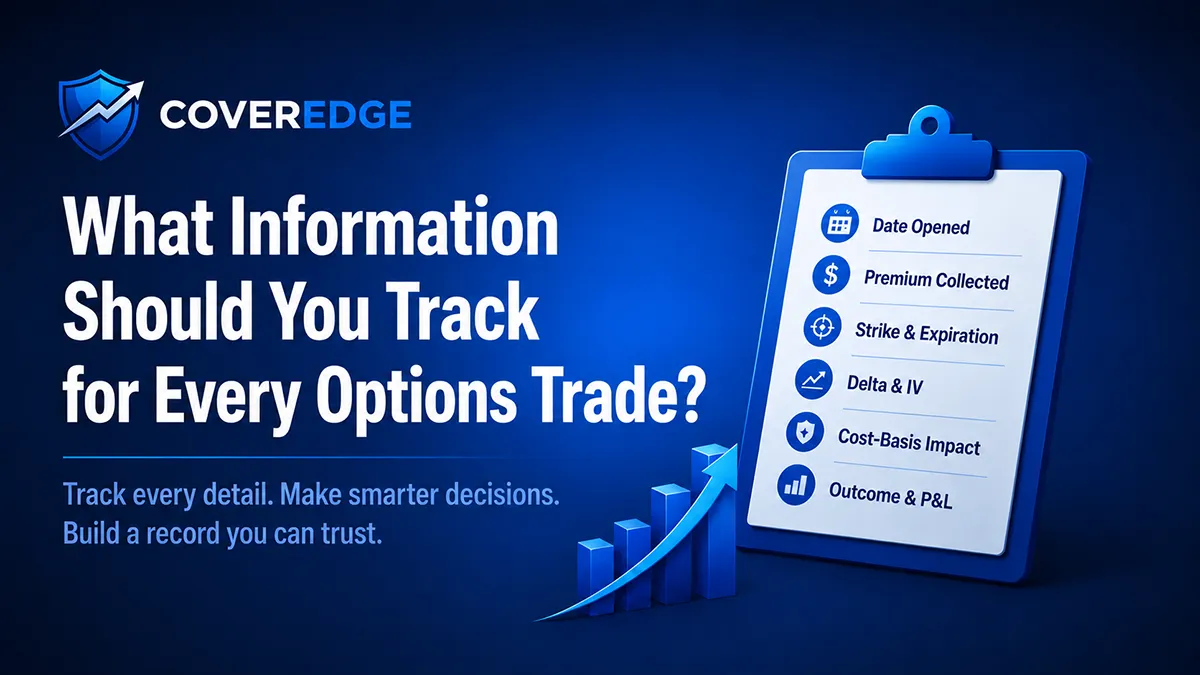
For every options trade, record more than the strike and premium. At entry, capture the date, underlying and strategy, number of contracts, strike and expiration, premium collected (net of fees), delta and implied volatility, and the cost-basis impact. At the outcome, record the close debit, expiration, roll legs (both the buy-to-close and sell-to-open, linked to the original position), assignment and its cost-basis change, and fees on every leg. Then add the 'why' fields — your thesis, IV percentile at entry, and review notes — that turn a log into a feedback loop. A ledger-first tracker like CoverEdge captures these automatically and derives cost basis, premium income, and realized P&L from an immutable record rather than hand-maintained formulas that drift.
Track your covered call & cash-secured put income with ledger-grade P&L in CoverEdge — free 14-day Pro trial, no card.
Start free trialAsk ten options sellers what they write down for each trade and you'll get ten different answers — and most of them are missing something that bites them later. The strike and the premium are the easy part. The fields that actually keep your P&L honest are the ones people skip: your cost-basis impact, the debit you paid to close, and the reason you put the trade on in the first place. This is the checklist of what to record on every options trade so your numbers stay trustworthy from the first sale through the final assignment.
Try the math on a real ticker — for free
Plug in any of 200+ tickers and get live premium, annualized yield, breakeven, and assignment P&L instantly. No signup, no credit card.
Why a consistent per-trade record beats memory and broker apps
Your broker shows you a list of transactions, not a story. It can tell you that you sold a call and later bought one back, but it won't tie those two legs together, carry your real cost basis through an assignment, or remind you why you chose that strike. Memory is worse: three weeks and two rolls later, you genuinely will not remember whether that AMD call was a 0.30-delta income trade or a deliberately-tight strike you were happy to be called away on.
A consistent per-trade record fixes both problems. The same fields, captured the same way on every trade, are what let you compare positions, review what worked, and — critically — reconstruct an accurate realized P&L at tax time. It's the difference between a journal you can actually learn from and a pile of confirmations. If you're still on a spreadsheet, our covered call tracker vs spreadsheet breakdown covers exactly where the manual approach starts to drift.
The core fields to capture when you open a trade
Capture these at the moment you sell to open. Doing it up front — while the trade is fresh — is far more reliable than reconstructing it later:
- Date opened — the anchor for days-to-expiration math and holding-period questions.
- Underlying & strategy — the ticker plus whether it's a covered call, a cash-secured put, or one leg of a wheel. Tagging the strategy is what lets you review a whole approach later, not just one-off trades.
- Contracts — how many. One contract is 100 shares of exposure, and it's the multiplier on every dollar figure below.
- Strike & expiration — the two numbers that define your obligation and your timeline.
- Premium collected — the credit you received, net of fees. This is your income, and it's the number people most often record before commissions and then wonder why their totals don't match their 1099.
- Delta and IV at entry — delta approximates your odds of assignment, and implied volatility tells you whether the premium was rich or thin when you sold. Recording them at entry is the only way to judge your strike selection honestly after the fact.
- Cost-basis impact — on a covered call, the premium lowers your effective basis on the shares; on a cash-secured put, it lowers your effective purchase price if assigned. This is the field spreadsheets almost always get wrong.
Not sure what your yield or breakeven actually works out to? Our guide to calculating covered call returns walks through the premium-yield, annualized-return, and breakeven formulas so the numbers you log are the right ones.
What to record when you close, roll, or get assigned
Opening a trade is only half the record. The outcome is where P&L is actually decided, and it's where most logs fall apart:
- Close (buy to close) — record the debit you paid and the date. Your realized gain on the option leg is the premium you collected minus this debit, minus fees.
- Expiration — if the option expires worthless, note it. You keep the full premium and the position is done. Track your options expiration dates deliberately so this outcome is a decision, not a surprise.
- Roll — a roll is two legs: a buy-to-close debit and a sell-to-open credit. Record both, and link them to the original position. A rolled trade isn't a new trade; it's the same position continuing. Our guide to tracking rolled options as a roll chain covers why the cumulative net credit across every roll is the number that matters.
- Assignment — record that shares were called away (covered call) or put to you (cash-secured put), at what price, and recalculate your cost basis accordingly. This is the event that permanently changes your position, so it can never be skipped.
- Fees on every leg — commissions and regulatory fees are small per trade but compound across a year of rolls. Netting them in is what separates an estimate from an audit-grade number.
The "why" fields that turn a log into a decision tool
Everything above is arithmetic. The fields that actually make you a better seller are the qualitative ones — and they take ten seconds to jot down at entry:
- Your thesis — one line on why you took the trade. "Happy to own at this strike," or "pure income, don't want to be called away." When you review later, this tells you whether the outcome matched the intent.
- IV percentile at entry — raw IV means little without context; IV percentile tells you whether volatility was genuinely rich when you sold. See IV rank vs IV percentile for how premium sellers use it.
- Notes for review — earnings inside the expiration window, an ex-dividend date, or a management rule you set ("close at 50% profit"). These are the details that decide outcomes and vanish from memory fastest.
Record these consistently and your log stops being a ledger of what happened and becomes a feedback loop for what to do next. If you want a fuller routine for the income side, see how to track options premium income.
How CoverEdge captures this automatically
CoverEdge is built around exactly this checklist, so you don't have to maintain it by hand. It's ledger-first: every trade you log writes an immutable ledger entry, and your cost basis, premium income, and realized P&L are all derived from that record rather than typed into a formula that can drift. Open a covered call and the premium flows in as income and lowers your basis; roll it and both legs are captured and linked into a single roll chain; get assigned and CoverEdge records it and recalculates your cost basis automatically.
A few things worth being precise about. CoverEdge is portfolio-scoped: each brokerage account maps to its own portfolio, and portfolios are kept separate rather than merged into one blended total — which is what keeps each account's numbers tax-accurate. You can connect an account read-only through a brokerage link (via SnapTrade) so trades import on their own, or log them by hand; either way the same accounting applies. It's decision-support, not advice — CoverEdge shows you clean, consistent numbers and leaves the call to you. And because rolls and assignments carry tax consequences, treat the tax side as educational and confirm your specific situation with a tax professional.
The point of a per-trade record isn't bookkeeping for its own sake. It's that when you know exactly what to capture — and something captures it consistently — every trade compounds into a clearer picture of what's actually working.
Frequently asked questions
What information should I track for every options trade?
At entry, record the date opened, the underlying and strategy (covered call, cash-secured put, or a wheel leg), the number of contracts, the strike and expiration, the premium collected net of fees, the delta and implied volatility at entry, and the cost-basis impact. At the outcome, record how the trade closed — a buy-to-close debit, expiration, roll (both legs), or assignment — plus fees on every leg. Adding your original thesis and IV percentile at entry turns the log into something you can actually learn from.
Why isn't my broker's transaction history enough?
A broker shows a list of transactions, not a linked position. It won't tie a buy-to-close back to the call you sold, carry your true cost basis through an assignment, or record why you chose a strike. Different brokers also calculate P&L differently. A consistent per-trade record — the same fields captured the same way every time — is what lets you compare trades, review what worked, and reconstruct an accurate realized P&L at tax time.
What's the most commonly missed field in an options trade log?
Cost-basis impact and fees. Most sellers record the headline premium but forget that it lowers their effective basis on a covered call (or their effective purchase price on a cash-secured put), and they omit the small commissions and regulatory fees that compound across a year of rolls. Missing those is why a spreadsheet's totals stop matching the broker's 1099. Recording the buy-to-close debit on the outcome side is the other frequent gap.
How does CoverEdge track this automatically?
CoverEdge is ledger-first: every trade you log writes an immutable ledger entry, and cost basis, premium income, and realized P&L are all derived from that record rather than typed into formulas. Rolls are captured as linked chains, assignments trigger an automatic cost-basis recalculation, and each account is kept in its own portfolio so the numbers stay tax-accurate. You can connect an account read-only via SnapTrade or log trades by hand — the same accounting applies either way.
Track every premium dollar with CoverEdge
AI-enhanced research, assignment-aware roll analysis, and ledger-grade P&L that survives every roll, close, and assignment. Decision-support, not advice — you decide.
No credit card required · Cancel anytime