Cash-Secured Put Assignment: What Happens, Cost Basis & Next Steps
Key takeaway
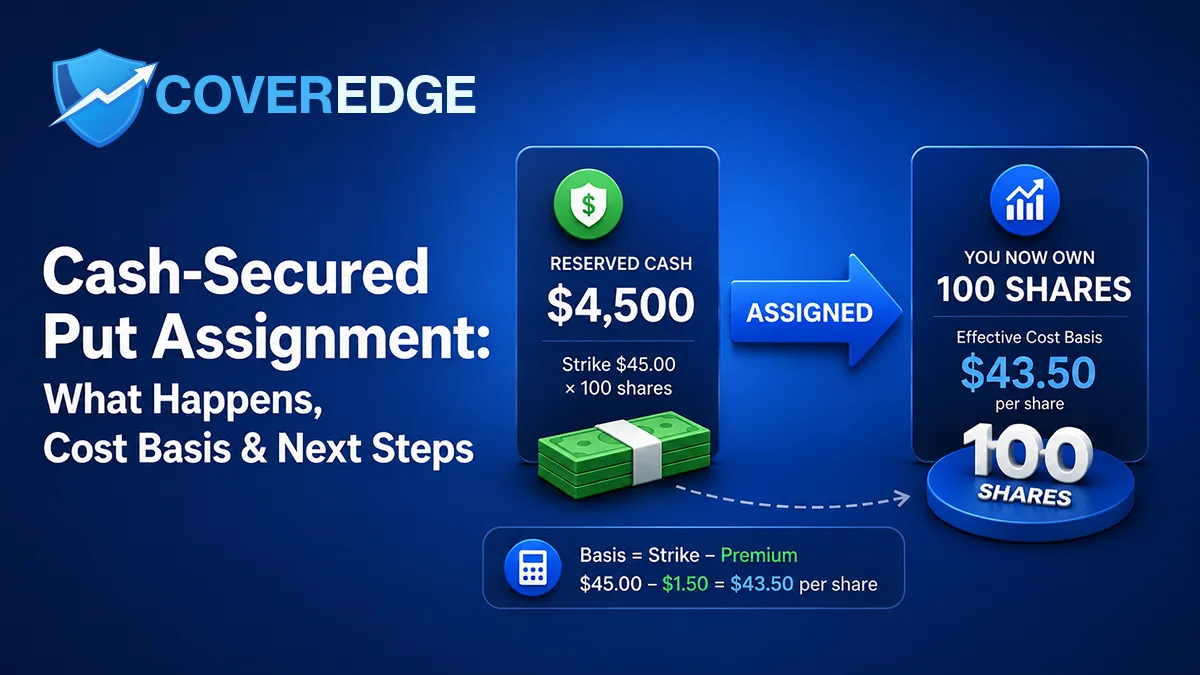
When a cash-secured put is assigned, the stock closed below your strike, so your reserved cash (strike × 100 per contract) is used to buy 100 shares at the strike and you keep all the premium you collected. Your effective cost basis is the strike minus the premium per share — e.g. a $45 put sold for $1.50 gives a $43.50 basis — so assignment is not automatically a loss; the position is up or down relative to that basis, not the strike. Early assignment is uncommon and, unlike calls, has no ex-dividend trigger; it's mainly a deep-in-the-money put near expiration. After assignment you can sell a covered call against the shares (the next leg of the wheel), hold, sell, or reassess your thesis.
Track your covered call & cash-secured put income with ledger-grade P&L in CoverEdge — free 14-day Pro trial, no card.
Start free trialGetting assigned on a cash-secured put is not a failure — it's the outcome you agreed to when you sold the put. The stock closed below your strike, so the cash you set aside is used to buy 100 shares per contract at the strike, and you keep every dollar of premium you collected. What matters next is knowing your real cost basis and deciding what to do with the shares. Here's exactly what happens and how to handle it.
Try the math on a real ticker — for free
Plug in any of 200+ tickers and get live premium, annualized return, breakeven, and effective cost basis instantly. No signup, no credit card.
What Happens When a Cash-Secured Put Is Assigned
When the stock is below your put's strike at expiration (or the buyer exercises early), your reserved cash is converted into shares. The mechanics:
- You buy 100 shares per contract at the strike price.
- The cash you set aside as collateral (strike × 100) leaves your account.
- The put disappears from your positions.
- You keep the premium you originally collected — it was always yours.
This is the mirror image of covered call assignment: a covered call assignment converts shares into cash, while a cash-secured put assignment converts cash into shares. If you already know the covered-call side, you know both halves of the wheel strategy.
The Assignment Timeline
Assignment usually happens at expiration, and the shares settle into your account over the weekend for a standard Friday expiration:
- Expiration day. If the stock closes even one cent below your strike, the put finishes in the money and is assigned automatically. You do not have to do anything.
- Assignment notice. Your broker assigns the contract and reserves the purchase; you may not see the shares until the next business day.
- Settlement. The 100 shares per contract land in your account at the strike price, and the collateral cash is gone. From here, the position is just stock you own — with a cost basis you should record precisely.
Calculating Your Cost Basis After Assignment
The single most important number is your effective cost basis — what those shares actually cost you after the premium is counted:
Effective Cost Basis = Strike − Premium Collected (per share)
Example: You sold the $45 put for $1.50, collecting $150 in premium, and set aside $4,500 in cash. The stock drops to $43, so you're assigned 100 shares at $45.
- Shares acquired: 100 at the $45 strike = $4,500 paid
- Premium kept: $1.50 × 100 = $150
- Effective cost basis: $45 − $1.50 = $43.50 per share
So even though the stock is at $43, your true entry is $43.50 — below the $45 strike, with the premium doing the work. The premium lowered your basis by exactly the premium per share. You can check the effective cost basis for your own strike before you ever sell the put with the free cash-secured put calculator.
If you rolled the put before assignment, include every opening credit, closing debit, and fee when evaluating the chain's economic result. The worked guide to rolling a cash-secured put shows that calculation. Keep the chain-adjusted strategy basis distinct from broker tax-lot basis — an earlier closed put may be realized separately for tax reporting. This is exactly where a spreadsheet starts to drift.
Assignment Is Not the Same as a Loss
Being assigned means you now own the shares — it does not, by itself, mean you lost money. Whether the position is up or down depends on where the stock trades relative to your effective cost basis, not relative to the strike:
- Stock just below the strike. If you're assigned at $45 with a $43.50 basis and the stock is at $44, you're actually up $0.50 per share on paper. The premium more than covered the dip.
- Stock well below the strike. If the stock gapped to $38, your $43.50 basis is now underwater by $5.50 per share — an unrealized loss of $550 per contract. The premium softened it but didn't erase it. This is why you only sell cash-secured puts on names you genuinely want to own.
The takeaway: judge the assigned position against your effective cost basis, and remember that the downside of a cash-secured put below the strike is nearly identical to owning the shares outright — the premium is a cushion, not a hedge.
Early Assignment on Puts
American-style equity puts can be exercised before expiration, though it's uncommon. Early assignment on a put becomes more likely when the option is deep in the money and has almost no time value left, since the holder gains little by waiting. Unlike calls — where early assignment clusters around ex-dividend dates — put holders have no dividend incentive to exercise early, so the main trigger is simply a deep-ITM contract near expiration. Either way, the outcome is the same shares at the same strike; only the timing changes.
What to Do After You're Assigned
Once the shares settle, you have four clear options:
- Sell a covered call against the shares. This is the classic wheel move — you now own 100 shares, so you can generate more premium while you hold them. See how to pick a strike for a call above your effective cost basis so an eventual call-away locks in a profit.
- Hold the shares. If you sold the put because you wanted to own the stock, do nothing — you got in at a discount to the strike. Collect any dividend while you wait.
- Sell the shares. If your reason for wanting the stock has changed, you can exit. You still keep the premium; the stock result is a separate line.
- Reassess the thesis. A gap well below your strike is often news-driven. Decide whether the story that made you want the shares is still intact before you commit more capital by selling calls or averaging down.
How Assignment Starts the Covered-Call Side of the Wheel
The wheel strategy is just these two assignments in sequence: sell cash-secured puts until you're assigned shares, then sell covered calls on those shares until they're called away, then start over with cash. A put assignment isn't the end of a trade — it's the hand-off from the cash phase to the shares phase, with premium collected at every step. For a shortlist of names that work on both sides of that cycle, see the best stocks for the wheel strategy.
How to Handle Assignment in Your Tracker
When a cash-secured put is assigned, your tracking system needs to: (1) close the option trade as "assigned," (2) create the new 100-share stock position, (3) set the effective cost basis to strike minus premium collected, and (4) keep the collateral cash reconciled so your return isn't double-counted when cash becomes shares.
CoverEdge handles both sides of the wheel natively. When you confirm a put assignment, it treats the event as a share acquisition: the acquired shares are added to the position, the purchase cost is recorded, and your collected premium is automatically netted into the cost basis so your effective cost per share is always accurate. Because every step is an immutable ledger entry, your tax reporting reconciles trade by trade instead of forcing a spreadsheet rebuild in February. Treat the tax side as educational and confirm your specific situation with a professional. For the full picture of tracking every leg from the first put through the final call-away, see our wheel strategy tracker guide.
Assignment on a cash-secured put is a normal, planned part of selling premium. Know your effective cost basis, decide deliberately what to do with the shares, and the "worst case" becomes just the next phase of a repeatable income cycle.
Frequently asked questions
What happens when a cash-secured put is assigned?
The stock closed below your strike at expiration, so the cash you set aside as collateral is used to buy 100 shares per contract at the strike price, and you keep the premium you collected. The put leaves your account and you now own the shares. Your effective cost basis is the strike minus the premium per share, which is below the strike you were assigned at.
How do I calculate my cost basis after put assignment?
Take the strike price and subtract the premium you collected per share. If you sold a $45 put for $1.50, your effective cost basis is $43.50 per share even though you were assigned at $45 — the premium lowers your basis dollar for dollar. If you rolled the put before assignment, include all net premium collected across the chain and subtract any debit you paid to close an earlier leg.
Is getting assigned on a cash-secured put a bad thing?
Not if you only sold the put on a stock you wanted to own. Assignment simply means you bought the shares at a discount to the strike, since the premium lowered your effective cost basis. Whether the position is up or down depends on where the stock trades relative to that basis, not the strike. It only hurts when the stock gaps far below your strike or when you sold the put purely for premium on a name you didn't actually want.
What should I do after my cash-secured put is assigned?
You have four choices: sell a covered call against the new shares to keep collecting premium (the next leg of the wheel strategy), hold the shares if you wanted to own them, sell the shares if your thesis has changed, or reassess before committing more capital when a gap-down was news-driven. Many wheel traders sell a covered call at a strike above their effective cost basis so an eventual call-away locks in a profit.
Track every premium dollar with CoverEdge
AI-enhanced research, assignment-aware roll analysis, and ledger-grade P&L that survives every roll, close, and assignment. Decision-support, not advice — you decide.
No credit card required · Cancel anytime