Wheel Strategy Tracker: How to Track Every Put, Call, Roll & Assignment
Key takeaway
A wheel strategy tracker must preserve one auditable history as reserved cash becomes a short put, put assignment becomes shares, and those shares back covered calls. Record every opening credit, buy-to-close debit, fee, assignment, roll, and stock sale, then separate net option cash flow from the stock gain. Compute the cycle result either from raw cash flows or from a premium-adjusted basis — never both, or you double-count every dollar of premium. Keep that economic adjusted basis distinct from your broker's tax basis, and measure return against the maximum cash the cycle secured, not against the premium collected.
Track your covered call & cash-secured put income with ledger-grade P&L in CoverEdge — free 14-day Pro trial, no card.
Start free trialA wheel strategy tracker has one job: keep a single, honest history as cash becomes a short put, put assignment becomes shares, and those shares back a covered call — then back to cash when the shares are called away. That sounds simple until you have collected premium on both sides, rolled a contract twice, and taken an assignment. At that point your broker shows a pile of disconnected transactions, your spreadsheet shows a few premiums, and neither one answers the only question that matters: across this whole cycle, am I actually ahead, and by how much? This guide covers exactly what a wheel tracker has to record, a worked full-cycle example, the metrics that tell you whether the wheel is working, and how to avoid the double-counting trap that quietly inflates most wheel spreadsheets.
This article is educational, not investment or tax advice. Options involve risk and are not suitable for every investor. Every figure below is illustrative and ignores anything not explicitly stated. Confirm your own tax treatment with a professional.
Stop rebuilding your wheel in a spreadsheet
Track puts, calls, assignments, rolls, and fees from one auditable ledger — with cost basis and cumulative P&L derived automatically. Start a free 14-day Pro trial. No credit card required.
What a Wheel Strategy Tracker Actually Tracks
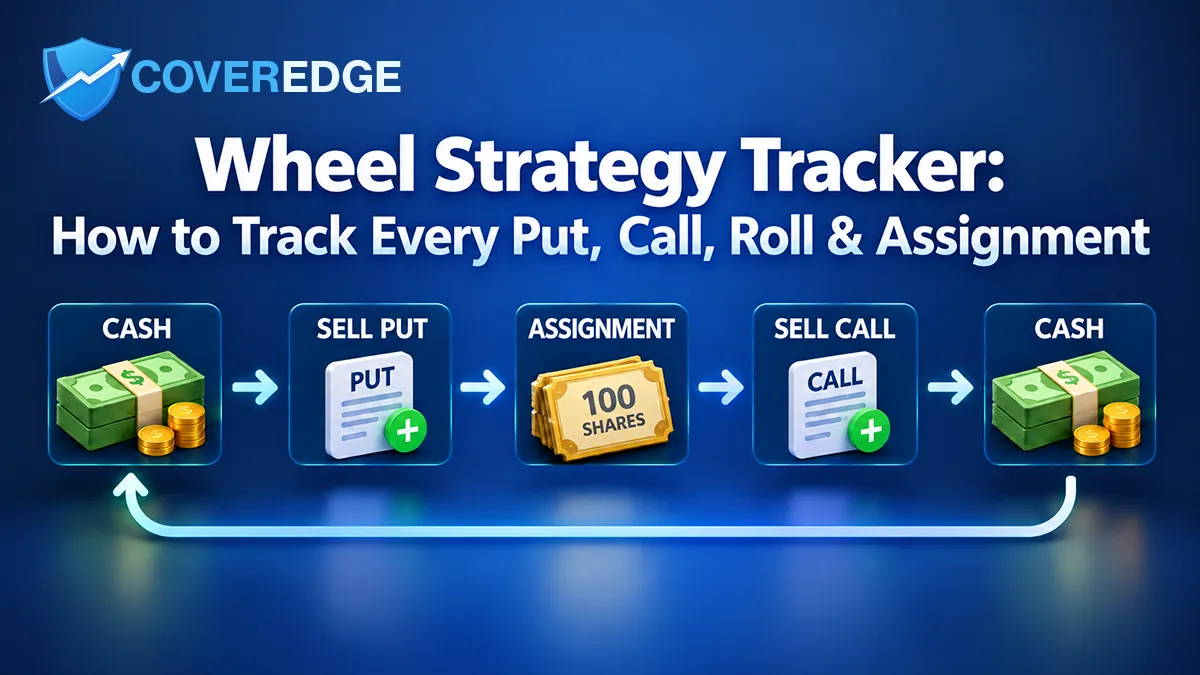
The wheel is not a set of unrelated option trades. It is one continuous position that keeps changing form. A tracker built for it has to follow every one of those transitions without dropping a leg:
Across that loop, a complete wheel produces eight kinds of records, and every one of them moves money or ownership:
- Reserved cash — the strike × 100 you must set aside to secure the put.
- Put premium received — the opening credit on the short put.
- Put resolution — the put expires, is closed, is rolled, or is assigned.
- Shares acquired — assignment converts reserved cash into 100 shares at the strike.
- Call premium received — the opening credit on the covered call sold against those shares.
- Call resolution — the call expires, is closed, is rolled, or is assigned.
- Shares disposed — call assignment sells the 100 shares at the strike and returns you to cash.
- Fees — commissions and regulatory fees at every open, close, and assignment.
Miss any one of those — a buy-to-close debit, an assignment, a fee — and your cycle result is wrong. The whole point of a wheel tracker is that it never lets a leg go unrecorded, and that it keeps the legs linked so you can still see the one position underneath them.
Why Brokerage Statements Lose the Strategy-Level Story
Your brokerage statement is accurate — it is just built for a different purpose. It is a tax and compliance record of individual transactions, not an analysis of a strategy that spans months. So it faithfully reports every fill and still cannot answer:
- What is the cumulative net premium I have collected on this underlying?
- Which new option replaced which old one when I rolled?
- What did this entire wheel cycle earn, put premium through final share sale?
- How much capital was actually committed, and for how long?
- Which premiums have already reduced my effective basis, so I do not count them twice?
This is the same gap a dedicated covered call tracker closes for a single-leg strategy — only the wheel makes it worse, because the position changes between an option and stock and back again. A broker records the roll's buy-to-close as a standalone realized loss; a wheel tracker keeps it attached to the chain it belongs to.
The Seven Records Every Wheel Tracker Needs
Whether you use software, a spreadsheet, or a notebook, these are the records that keep a wheel honest. The hard part is never capturing one of them — it is keeping them linked as one position.
| Record | What it must capture |
|---|---|
| Opening short option | Symbol, put/call, strike, expiration, contracts, credit received, date |
| Closing transaction | Buy-to-close debit, fees, date — the leg most often forgotten |
| Expiration | Final worthless-expiry status and the realized option result |
| Roll | Old close linked to the new open, with net and cumulative credit carried forward |
| Assignment | Shares acquired or sold, the strike, the date, the contract count |
| Stock position | Shares held, acquisition basis, and disposition proceeds when called away |
| Fees | Opening, closing, assignment, and regulatory fees at every step |
Notice that a roll is two transactions, not a reset. When you track a rolled position, you buy to close the current contract (a debit) and sell to open a new one (a credit); the number that matters is the net, carried forward across the whole chain.
A Worked Example: One Complete Wheel Cycle
Numbers make the accounting concrete. Here is a single, internally consistent cycle on a stock trading around $48. Every figure is illustrative and ignores taxes.
Phase 1 — The Cash-Secured Put
- Sell one $47.50 put for a $1.20 credit: +$120. Reserved cash: $4,750.
- The stock dips and the put is assigned: you buy 100 shares at $47.50 = $4,750.
- Effective entry basis after the put premium: $47.50 − $1.20 = $46.30/share.
Phase 2 — The Covered Call (with a Roll)
- Sell one $50 call for $0.90: +$90.
- The stock rallies toward the strike; you buy that call back for $1.40: −$140.
- You immediately sell a new $52.50 call for $1.80: +$180.
- Net result of that roll: −$140 + $180 = +$40.
- The stock finishes above $52.50 and the shares are called away for $5,250.
Full-Cycle Result
| Line item | Amount |
|---|---|
| Put credit | +$120 |
| First call credit | +$90 |
| Buy-to-close debit | −$140 |
| Replacement call credit | +$180 |
| Net option cash flow | +$250 |
| Shares purchased (put assignment) | −$4,750 |
| Shares sold (call assignment) | +$5,250 |
| Stock gain | +$500 |
| Full-cycle profit (before fees & taxes) | +$750 |
Against the $4,750 of maximum secured capital, $750 is a 15.8% return on the capital the cycle actually tied up. If the cycle ran about 60 days, that is roughly $12.50 a day the capital was working — a far more useful figure than any single premium.
The Double-Counting Trap
Here is where most wheel spreadsheets quietly go wrong. You can compute the result two valid ways, but you must not mix them:
- From raw cash flows: add every credit and debit and the stock proceeds, exactly as the table above does. Full-cycle profit = +$750.
- From adjusted basis: lower your $47.50 share basis by all $250 of net premium to $45.00, then compare to the $52.50 sale: ($52.50 − $45.00) × 100 = $750. Same answer.
The trap is doing both — subtracting the premiums into an adjusted basis of $45.00 and then adding the $250 of premium again on top. That reports $1,000 and overstates the cycle by every dollar of premium collected. A good wheel tracker picks one model and applies it consistently. And note that this economic adjusted basis is for strategy analysis; your broker's tax basis may treat the premium differently, so keep the two figures separate rather than assuming they match.
The Metrics That Tell You Whether the Wheel Is Working
Once the accounting is clean, a handful of measures — not gross premium — tell you whether the strategy is actually paying you for the risk and capital involved:
- Cumulative net option cash flow. Every credit minus every buy-to-close debit and fee. This is real option income, not the headline premiums.
- Full-cycle realized P&L. Option cash flow plus the stock outcome, the moment the cycle closes.
- Maximum secured capital. The most cash the cycle tied up — the true denominator for return, not the premium received.
- Return on secured capital. Full-cycle profit ÷ maximum secured capital.
- Cycle duration and dollars per day. Profit ÷ the days from the first put to the final call-away, so you can compare a fast cycle to a slow one.
- Assignment frequency. How often puts and calls actually assign — tracked separately, because they mean different things.
- Open vs realized P&L. What is banked versus what is still riding on open positions.
- Concentration. How much capital is committed to each underlying, so one name does not quietly become the whole account.
For the broader version of this — the metrics that matter for any premium strategy, not just the wheel — see how to track options premium income.
Spreadsheet vs Brokerage Statement vs Wheel Tracker
None of these is wrong; they are built for different jobs. A spreadsheet is genuinely fine for one or two simple positions with no rolling. The trouble starts once the wheel turns.
| Capability | Brokerage statement | Spreadsheet | Purpose-built tracker |
|---|---|---|---|
| Official transaction record | Strong | Manual | Imported or manual |
| Link roll chains | Usually not | Hand-built formulas | Native |
| Follow put assignment into shares | Transactional only | Manual | Lifecycle-aware |
| Net cumulative premium | DIY | Formula-based | Derived |
| Fees captured consistently | Fragmented | Easy to omit | Ledger-based |
| Multiple portfolios / accounts | Account-based | Manual tabs | Portfolio-scoped |
| Audit trail | Strong | Editable / fragile | Immutable ledger |
| Strategy-level analytics | Limited | DIY | Built in |
Seven Wheel-Tracking Mistakes
- Counting opening credits but not closing debits. Gross premium is not income; net of buy-to-close is.
- Treating a roll as a brand-new, unrelated trade. It is two legs of one chain; only the net matters.
- Recording put assignment as a realized loss. It is not a loss — it is you buying shares you agreed to buy, at a basis the premium already lowered.
- Resetting the history when puts become shares. The premium collected on the put side still belongs to the cycle.
- Double-counting premium through adjusted basis. Lower the basis or add the premium — never both.
- Ignoring fees because they are small. Across dozens of legs a year, they are a real line item.
- Assuming economic basis equals tax basis. They often differ; track the economic figure for strategy, and reconcile to the broker for taxes.
What to Look for in a Wheel Strategy Tracker
Use this as a buyer's checklist, whatever tool you evaluate:
- Cash-secured puts and covered calls with equal, first-class lifecycle support
- Explicit open, close, expire, assign, and roll statuses — no ambiguity
- Roll chains that link the old contract to the new one automatically
- Assignment that updates your share position and cost basis for you
- Fees captured at every leg, not left to memory
- P&L derived from an auditable record, not typed in by hand
- Separate portfolios or accounts so taxable and IRA numbers stay accurate
- Brokerage import with a preview and deduplication, plus a manual-entry fallback
- CSV export and visible market-data timestamps
- A read-only brokerage connection that never places trades
How CoverEdge Tracks the Wheel
CoverEdge was built for exactly this cycle. It tracks cash-secured puts and covered calls with identical lifecycle support — open, close, expire, assign, or roll — on a ledger-first model, where every premium, buy-to-close debit, fee, and assignment is an immutable entry and your P&L, cost basis, and income are always derived from that record rather than typed in.
- Rolls stay linked. A rolled contract keeps its chain, so cumulative net credit is always visible instead of fragmenting into loose rows.
- Assignment flows through automatically. A put assignment creates the share position at the strike; a call assignment closes it — and the effective basis nets every premium collected along the way.
- Both sides are equal. The put entry leg and the covered-call exit leg of the wheel are tracked with full parity, across as many portfolios as you run.
- Brokerage sync is read-only. Trades import through SnapTrade with an import preview and deduplication; CoverEdge never places an order or tells you what to buy or sell.
For the strategy itself — how the cycle works, phase by phase — start with the wheel strategy explained, then see what happens the moment a put fills in the cash-secured put assignment guide and the covered call assignment guide. This page is about keeping the score once you are running it. You decide the trades; CoverEdge keeps the numbers honest.
Frequently asked questions
What is the best way to track the wheel strategy?
Track the wheel as one linked position rather than as separate trades. Record every leg — the cash-secured put's opening credit, any buy-to-close debit, assignment into shares, the covered call's credit, rolls, fees, and the final stock sale — and keep them connected so you can see cumulative net premium and full-cycle P&L. A spreadsheet works for one or two simple positions, but a purpose-built tracker with roll-chain linking and automatic cost-basis updates is what keeps the numbers accurate once you start rolling and taking assignments.
How do you calculate profit on a complete wheel cycle?
Add your net option cash flow (every credit minus every buy-to-close debit and fee) to your stock result (sale proceeds minus purchase cost). For example, +$250 net premium plus a $500 stock gain is a $750 full-cycle profit. You can equivalently lower your share basis by the net premium and compare to the sale price — but do only one of those, never both, or you double-count the premium.
Should put and call premiums reduce your cost basis?
For economic analysis, yes — netting the premiums you collected into an adjusted cost basis is a valid way to see your true breakeven and cycle return. Just don't also add those same premiums as separate income, or you count them twice. Note that this economic adjusted basis is for strategy tracking; your broker's tax basis may treat option premium differently, so keep the two figures separate and reconcile to the broker at tax time.
How should rolled options be recorded in a wheel tracker?
A roll is two transactions — you buy to close the current contract (a debit) and sell to open a new one (a credit) — not a fresh, unrelated trade. Record both legs and carry the net credit forward across the chain, so your cumulative income stays accurate no matter how many times you roll. Treating each roll as a standalone trade is one of the fastest ways to lose the thread on a wheel position's real P&L.
Does put assignment mean the wheel trade lost money?
No. Put assignment simply means you bought the 100 shares you agreed to buy, at a strike you chose, with an effective basis the premium already lowered. It is the expected middle of the wheel, not a loss — you now own shares and sell covered calls against them. Recording assignment as a realized loss is a common tracking mistake that makes a normal cycle look like a losing one.
Track every premium dollar with CoverEdge
AI-enhanced research, assignment-aware roll analysis, and ledger-grade P&L that survives every roll, close, and assignment. Decision-support, not advice — you decide.
No credit card required · Cancel anytime