How to Roll a Cash-Secured Put: Down, Out, or Take Assignment?
Key takeaway
To roll a cash-secured put, buy to close the current short put and sell to open a new one at a later expiration, a lower strike, or both. Calculate the roll as new credit minus the old closing debit, then keep every leg connected: rolling changes the contract but does not erase the realized result on the old put. Roll only when the new contract is one you would willingly sell today and the stock thesis is intact; otherwise, accepting assignment at your chain-adjusted basis or closing to release the cash may be cleaner.
Track your covered call & cash-secured put income with ledger-grade P&L in CoverEdge — free 14-day Pro trial, no card.
Start free trialRolling a cash-secured put means buying back the put you sold and opening a new short put — usually at a later expiration, a lower strike, or both. A roll can buy time and improve your potential entry price, but it does not erase the loss on the old contract. The useful test is whether the new put is a trade you would willingly open today, after counting the closing debit, the new credit, the added time, and the cash still at risk.
This guide is educational, not a recommendation to roll or accept assignment. Taxes, transaction costs, buying power, and your view of the underlying all affect the decision.
Try the math on a real ticker — for free
Plug in any of 200+ tickers and get live premium, annualized return, breakeven, and effective cost basis instantly. No signup, no credit card.
What Rolling a Cash-Secured Put Actually Does
A put roll contains two separate option trades:
- Buy to close the current short put, paying a debit and ending that obligation.
- Sell to open a new put, collecting a credit and accepting a new obligation to buy 100 shares per contract.
Your broker may display both legs as one order, but the economics stay separate. The old put realizes a gain or loss when it is closed. The new put starts a fresh contract with a new strike and expiration. Linking the legs as one roll chain is what lets you see the strategy's cumulative result without pretending the closing loss disappeared.
roll net = new put credit − old put closing debit
chain premium = all opening credits − all closing debits − fees
A positive roll net is a credit; a negative roll net is a debit. The chain total also includes the premium from the original put and every earlier roll.
The Three Common Put Rolls
Roll Out: Same Strike, Later Expiration
Rolling out keeps the strike and adds time. The later-dated put usually carries more time value, which may make a net credit possible. Your purchase obligation does not improve, though: if assigned, you still buy at the same strike. You are accepting more calendar risk in exchange for more premium and more time for the stock to recover.
Roll Down: Lower Strike
Rolling down lowers the price at which you may have to buy the shares. A lower strike also reduces the cash collateral required. Within the same expiration, however, the lower-strike put is normally worth less than the put you are closing, so a same-date roll down often costs a debit. Judge that debit against the actual improvement in strike — not against the desire to avoid seeing an assignment.
Roll Down and Out: Lower Strike, Later Expiration
Down-and-out is the common defensive put roll. Moving to a later date adds enough time value that you may be able to lower the strike while still receiving a net credit. The trade-off is explicit: a better potential entry price in exchange for staying obligated longer. More time is not free risk reduction; the stock can keep falling while your cash remains committed.
A Worked Down-and-Out Example
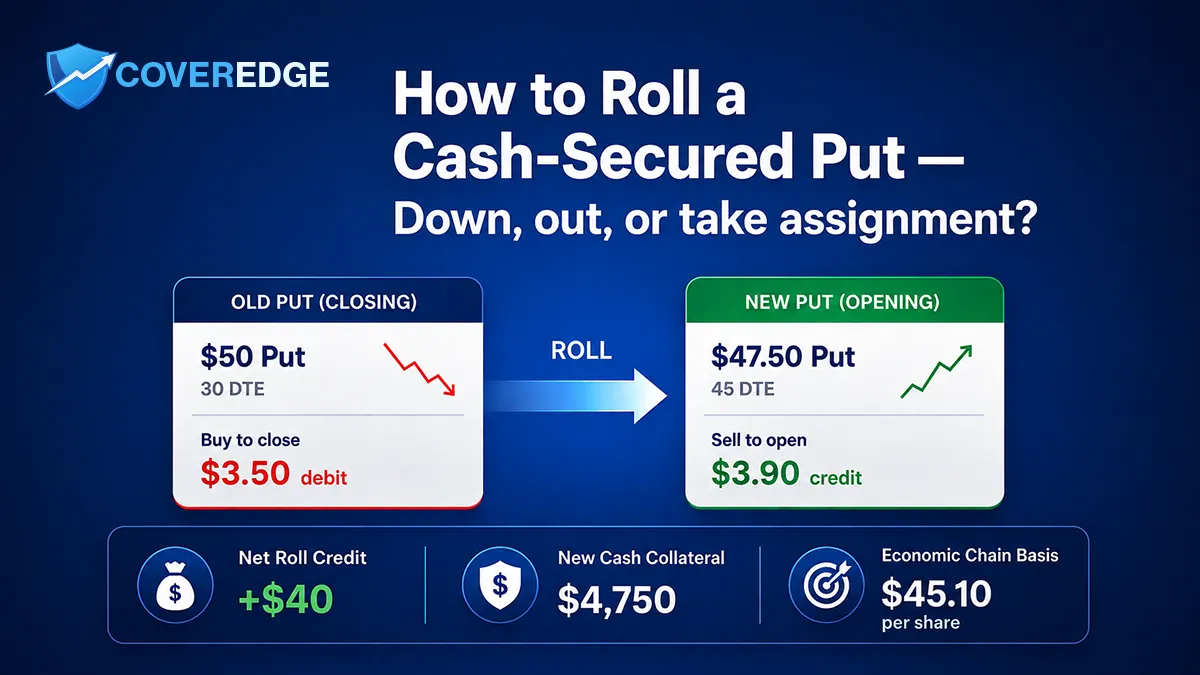
Assume you sold one 30-day $50 put for $2.00, collecting $200 and reserving $5,000. Near expiration the stock trades at $47 and the old put costs $3.50 to close. A 45-day $47.50 put can be sold for $3.90. Using illustrative midpoint prices before fees:
- Buy to close the old $50 put: −$350
- Sell to open the new $47.50 put: +$390
- Net credit on the roll: $40
- Total chain premium: $200 − $350 + $390 = $240
- New cash collateral: $4,750
- If later assigned: economic chain basis = $47.50 − $2.40 = $45.10 per share
The roll lowered the strike by $2.50, reduced collateral by $250, and added $40 of premium. It also added 45 days of exposure. That is the full comparison. Calling it a “$40 credit” without showing the old closing debit and the extra time would hide most of the decision. This $45.10 is a strategy-level economic measure. Your broker may report the new shares with a different tax basis because the loss on the closed $50 put can be realized separately; confirm tax treatment with a qualified professional.
Quotes near the bid and ask can change the result materially. Use a limit order for the combined roll and evaluate the price you can actually fill, especially on a chain with a wide spread. The guide to option liquidity explains why the midpoint is an estimate, not a promise.
Roll, Close, or Take Assignment?
Start with the stock thesis, then compare the three paths:
- Roll when the thesis is intact and the new contract stands on its own. The new strike should be a price you still want, the added time should be acceptable, and the net economics should compensate you for keeping the obligation.
- Take assignment when you still want the shares at the effective basis. Assignment is the outcome a cash-secured put was built to fund. If the original plan was to own the stock, paying repeatedly to avoid ownership can contradict the strategy.
- Close without rolling when the thesis has changed. Buying back the put realizes the result and releases the collateral. Opening another put on a stock you no longer want only extends the same risk.
If assignment is likely, calculate the real entry before deciding. The cash-secured put assignment guide shows how premium and prior roll debits flow into effective cost basis, and what happens when reserved cash becomes shares.
When a Net Debit Can Still Be Rational
“Only roll for a credit” is a useful guardrail, not an accounting law. A small debit can be rational if it buys a meaningful strike reduction and the resulting contract is still one you want. Compare the debit per share with the strike improvement:
net entry improvement = strike reduction − roll debit per share
Paying $0.40 per share to lower the strike by $2.00 improves the potential entry by $1.60, before fees. It can still be a poor trade if the thesis broke or the added duration is too long.
A debit is not justified merely because assignment feels uncomfortable. It should purchase a specific economic improvement — normally a lower strike — that matters more than its cost.
Four Rolling Mistakes to Avoid
- Calling every new credit profit. Subtract the buy-to-close debit and fees first, then include the original premium to get cumulative chain P&L.
- Rolling a stock you no longer want. More time does not repair a broken thesis. It only delays the point at which you acknowledge it.
- Ignoring the event calendar. A roll can move the new put across an earnings report or another known catalyst. The later expiration may carry risk the old contract did not.
- Using the midpoint as the expected fill. A wide spread can consume the apparent credit. Work the combined order with a limit and record the actual fills and fees.
A Six-Question Put-Roll Checklist
- Would I sell the proposed new put today if I had no existing position?
- Do I still want to own the stock at the new strike?
- What is the exact closing debit, new credit, and net roll amount after fees?
- How does the roll change my collateral and chain-adjusted assignment basis?
- What earnings or other events fall inside the new expiration window?
- Is rolling better than simply accepting shares or closing and releasing the cash?
Track the Roll as One Chain, Not a Reset
A brokerage statement records the old put's close and the new put's opening as separate tax lots. Your strategy journal should preserve those facts while also linking them into one chain. Keep the original credit, every closing debit, every new credit, fees, strikes, expirations, and the final close, expiration, or assignment together.
That chain view prevents a common illusion: showing the new premium as income while burying the larger debit paid to close the prior leg. The article on tracking rolled options covers the recordkeeping in detail. In CoverEdge, linked roll legs preserve cumulative net P&L and carry the full premium history into assignment-aware cost-basis analysis, so a roll changes the contract without rewriting the past.
Frequently asked questions
How do you roll a cash-secured put?
Buy to close the short put you already sold, then sell to open a new put — usually at a later expiration, a lower strike, or both. The difference between the new credit and the old closing debit is the roll's net credit or debit. The old contract realizes its own result when closed; the new contract begins a fresh obligation to buy 100 shares per contract if assigned.
Should I roll a cash-secured put or take assignment?
Start with whether you still want the stock. Assignment can be the planned outcome when you want the shares at the chain-adjusted basis. A roll is more defensible when the thesis remains intact, the new strike is still an entry you want, the added time is acceptable, and the new contract is a trade you would willingly open even without the existing position. If the thesis broke, closing without another put may be cleaner.
Can you roll a cash-secured put for a net debit?
Yes. A small debit can be economically rational when it buys a meaningful strike reduction: paying $0.40 per share to lower the strike by $2.00 improves the potential entry by $1.60 before fees. But a debit is not justified merely to postpone assignment. Compare the strike improvement, added duration, collateral, event risk, and whether you still want the stock.
Does rolling a put avoid a loss?
No. Buying back the old put realizes its gain or loss; selling a new put adds a new credit and a new obligation. A broker may present both legs as one roll ticket, but the closing debit does not disappear. Track the original credit, every closing debit, every new credit, and all fees as one linked chain to see the strategy's cumulative P&L and assignment basis honestly.
Track every premium dollar with CoverEdge
AI-enhanced research, assignment-aware roll analysis, and ledger-grade P&L that survives every roll, close, and assignment. Decision-support, not advice — you decide.
No credit card required · Cancel anytime