Best DTE for Covered Calls: 7, 21, 30, or 45 Days?
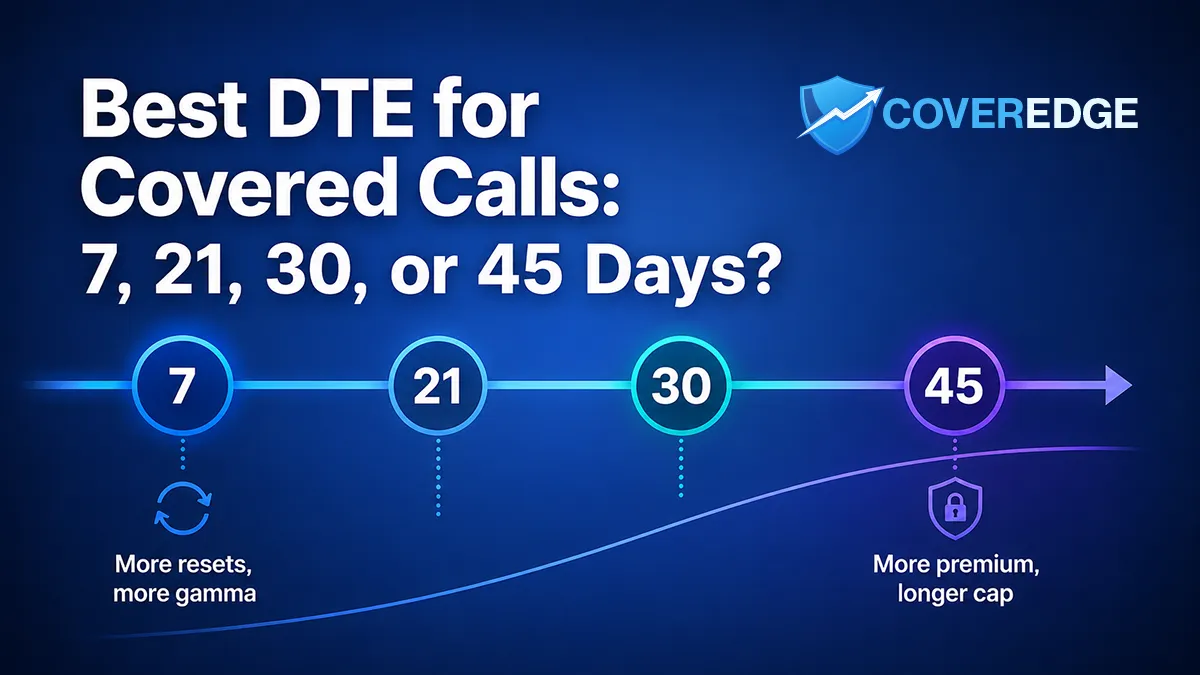
Key takeaway
There is no universally best DTE for covered calls. Roughly 7-14 DTE gives active sellers frequent strike resets but the most near-expiration gamma risk; 21-30 DTE is a practical middle ground between premium, time decay, and room to adjust; and 30-45 DTE collects more premium up front with fewer opening decisions but caps the shares for longer. Compare similar deltas using the executable bid, check earnings and ex-dividend dates, and judge both period return and annualized return - the shortest contract can look best annualized while demanding more fills, attention, and assignment decisions.
Track your covered call & cash-secured put income with ledger-grade P&L in CoverEdge — free 14-day Pro trial, no card.
Start free trialThe best days to expiration (DTE) for a covered call depends on the job you want the trade to do. Seven-day calls offer fast feedback and frequent strike resets, but they bring sharp gamma risk and more decisions. Calls around 21–30 DTE balance time decay, premium, and room to adjust. Calls around 30–45 DTE collect more premium up front and need less frequent management, but they keep your shares committed through more calendar risk. There's no universally best number — the useful goal is to choose the shortest window you can manage without letting a flattering annualized return hide the risk.
This guide is educational, not a recommendation to use a particular expiration. Option pricing, taxes, fees, dividends, earnings, liquidity, and your willingness to sell the shares all affect the choice.
Try the math on a real ticker — for free
Plug in any of 200+ tickers and get live premium, annualized yield, breakeven, and assignment P&L instantly. No signup, no credit card.
What DTE Changes in a Covered Call
DTE is the number of calendar days until an option expires. Changing it affects more than how long you wait. It changes the dollars collected, the rate of time decay, the option's sensitivity to a stock move, the number of known events inside the contract, and how often you may need to close, roll, or accept assignment.
- More DTE usually means more premium dollars. You are selling more time, although not at a constant price per day.
- Less DTE usually means faster decisions. A short-dated option can lose time value quickly, but its delta can also change quickly when the stock moves near the strike.
- More DTE means more calendar exposure. There is more time for a rally, earnings report, ex-dividend date, or market shock to change the position.
- Less DTE means more cycles. More openings, closes, rolls, spreads, fees, and opportunities for execution mistakes must be counted.
DTE does not set assignment risk by itself. Strike, delta, stock movement, dividends, and volatility matter too. A seven-day 0.15-delta call and a 45-day 0.40-delta call are not a fair test of expiration length. When comparing windows, hold the underlying, strategy, and target delta as close as practical.
Covered Call DTE Ranges at a Glance
| Opening DTE | Main advantage | Main trade-off | Management fit |
|---|---|---|---|
| 0–7 | Fast decay and frequent strike resets | Highest near-strike gamma; smallest credit per cycle | Very active |
| 8–20 | Short cycle with some room to react | Still sensitive as expiration approaches | Active |
| 21–30 | Balanced premium, decay, and flexibility | Requires a plan as the call enters its final week | Moderate |
| 31–45 | More premium up front and fewer openings | Shares stay capped longer; more event exposure | Lower frequency |
| 46–60+ | Largest initial credit among comparable strikes | Slower capital turnover and a long upside cap | Patient |
These are decision ranges, not performance promises. Moneyness changes the decay curve: near-the-money and out-of-the-money options do not lose time value in exactly the same way. The practical comparison is always the live bid, spread, delta, event calendar, and return for the exact contract.
Why 7 DTE Appeals to Active Sellers
A seven-day call gives you a new strike decision every week. If the stock rises, you may reset higher on the next cycle; if it falls, you have not capped a rebound for a full month. The short clock also makes time decay visible quickly when the stock stays away from the strike.
The cost is gamma. Gamma measures how quickly delta changes as the stock moves. Near expiration, a call close to the strike can move from low assignment odds to high assignment odds in one session. There is less time for the position to recover and less extrinsic value available to make a roll attractive. Weekly selling also multiplies execution friction: four small credits are not automatically better than one larger credit after spreads, fees, idle days, and imperfect fills.
Short DTE fits someone who can monitor the position, is comfortable making frequent assignment decisions, and trades contracts with tight spreads. The guide to weekly covered calls explains why liquidity becomes especially important on this schedule.
Why 21–30 DTE Is a Useful Middle Ground
The 21–30 DTE range gives a covered call enough time value to collect a meaningful credit while leaving more room to respond than a weekly. It also reaches the part of the option's life where time decay is becoming more important without starting directly inside expiration-week gamma risk.
This window is not magic. A stock can still gap through the strike, and the call eventually becomes a short-dated option if you keep holding it. Its advantage is operational: you can set a strike, define an early-close or roll checkpoint, and avoid making the same decision every Friday. For many sellers, that balance is easier to execute consistently than either extreme.
Why Some Sellers Start Around 30–45 DTE
A 30–45 DTE call normally pays more dollars up front than a comparable shorter call because the buyer receives more time. It also begins with less near-expiration sensitivity, so one ordinary stock move is less likely to force an immediate decision. Fewer openings can reduce transaction friction and monitoring load.
You pay for that calm with commitment. Your upside is capped at the strike for longer, and the contract may span earnings, an ex-dividend date, or several macro events. If the stock falls, the longer-dated call may retain enough value that buying it back is not as cheap as expected. If the stock rallies, you may spend weeks watching a profitable share position remain capped.
A common management approach is to open farther out and reassess before the final 7–14 days, rather than automatically holding through expiration. The right checkpoint depends on the remaining dollars, remaining time, and whether assignment is acceptable — not a universal percentage rule. See the guide to closing a covered call early.
The Annualized-Return Trap
Annualized return is useful for comparing contracts with different expirations, but it is an extrapolation — not a forecast. It assumes you can repeat a short trade all year at similar pricing with no gaps between cycles. Real trading includes weekends, earnings weeks you may skip, changing volatility, slippage, fees, assignment, and periods when no acceptable strike pays enough.
Consider two hypothetical calls on a $100 stock:
7 DTE: $0.60 bid ÷ $100 × 365 ÷ 7 = 31.3% annualized
30 DTE: $1.80 bid ÷ $100 × 365 ÷ 30 = 21.9% annualized
The weekly call displays the higher annualized figure, but it collects only $60 per contract, must be replaced roughly four times as often, and carries more expiration-week sensitivity. The 30-day call collects $180 and requires fewer fills, but caps the shares longer. Neither number tells you which obligation better fits your plan.
Use the executable bid rather than the midpoint for a conservative opening comparison, then evaluate both period return and annualized return. Period return shows what this contract can earn over its actual life. Annualized return helps normalize time, but it should never outrank liquidity, strike quality, event risk, or your willingness to sell the shares.
How to Choose a DTE Window
- Start with the share decision. Would you be satisfied selling the stock at the proposed strike during this window? If not, a richer premium does not repair the mismatch.
- Check the event calendar. Mark earnings, ex-dividend dates, product events, and other known catalysts before choosing an expiration. More DTE can quietly add a risk you never meant to sell.
- Compare similar deltas. Hold assignment odds roughly constant so you are testing DTE rather than accidentally testing two different strike strategies. The strike-selection guide provides the companion framework.
- Use realistic prices. Compare the bid, ask, spread percentage, and open interest. A theoretical midpoint is not income until somebody fills your order. Read covered call liquidity before relying on a thin chain.
- Measure dollars and time. Look at premium per contract, period return, annualized return, downside buffer, and days committed. No one metric is the decision.
- Match the window to your attention. A weekly strategy that requires four decisions per month is not superior if you can reliably review positions only twice a month.
- Define the next action before entry. Know when you will review an early close, when you would roll, and when you would accept assignment. A DTE choice without an exit plan is only half a plan.
A Practical Way to Think About the Choice
- Choose roughly 7–14 DTE when frequent flexibility matters, the option is highly liquid, and you can actively manage fast-changing assignment risk.
- Choose roughly 21–30 DTE when you want a middle ground between premium, time decay, and room to adjust without a weekly decision cycle.
- Choose roughly 30–45 DTE when collecting more premium up front and making fewer opening decisions matters more than frequent strike resets.
Those ranges are starting points for research, not rules. If the only liquid expiration is 18 days away, forcing a 30-day target can produce a worse trade. If the 35-day contract crosses earnings and the 24-day contract does not, the shorter window may be the cleaner comparison. The exact chain should overrule a favorite number.
Five DTE Mistakes to Avoid
- Picking the highest annualized return. Short expirations can win the annualization formula while losing after repeated spreads, fees, and management mistakes.
- Ignoring gamma near expiration. Fast theta is not free. Delta can change fastest when the stock is near the strike and little time remains.
- Comparing different deltas. A close weekly strike and a far-out monthly strike answer different assignment questions.
- Crossing an event accidentally. Always inspect earnings and ex-dividend dates before treating two expirations as interchangeable.
- Letting the schedule choose the trade. You do not owe the market a new weekly or monthly call. Skip a cycle when the strike, premium, or liquidity does not meet your plan.
A Seven-Question DTE Checklist
- Am I genuinely willing to sell the shares at this strike before this expiration?
- What earnings, dividend, or other known event falls inside the contract?
- How do the bid, spread, open interest, and delta compare across expirations?
- What are the premium dollars and period return — not just the annualized figure?
- How quickly could assignment risk change if the stock approaches the strike?
- Can I monitor and manage this position as often as the window requires?
- What will make me close, roll, expire, or accept assignment?
Compare Exact Expirations, Then Track the Outcome
Use the free covered call calculator to compare premium, period return, annualized return, downside buffer, and assignment outcome for exact contracts. The free covered call screener can then help you compare liquid setups using bid-based economics instead of chasing the largest headline yield.
Whichever DTE you choose, record the opening credit, actual fill, fees, closing debit, roll, expiration, or assignment. After enough completed trades, compare your own net dollars per day, return on capital, assignment rate, and management time by DTE bucket. The best window is not the one that looks most efficient in a formula; it is the one whose real, net outcomes you can execute consistently.
Frequently asked questions
What is the best DTE for covered calls?
There is no universal best DTE. Roughly 21-30 DTE is a useful middle ground for many sellers because it balances premium, time decay, and room to adjust. A 7-14 DTE window offers more frequent strike resets but greater near-expiration gamma and management load, while 30-45 DTE collects more premium up front but caps the shares longer. The better window is the one that fits your assignment plan, event calendar, liquidity, and how often you can review positions.
Are weekly or monthly covered calls better?
Weekly calls are more flexible and can show higher annualized returns, but they require more fills and expose the position to faster delta changes near expiration. Monthly calls generally collect more dollars per opening, require fewer decisions, and offer more time to react, but they cap the shares longer. Compare net outcomes after spreads and fees rather than assuming more cycles produce more income.
Why is gamma risk higher close to expiration?
Gamma measures how quickly an option's delta changes when the stock moves. With little time left, a call near the strike can shift from out of the money to likely assignment very quickly, so its delta can jump sharply in one session. Fast time decay and fast-changing assignment risk arrive together, so the extra theta from a short-dated call is not free.
Should I always sell covered calls 30 to 45 days out?
No. The 30-45 DTE range is a common starting point because it offers more premium and less immediate gamma pressure, but it can be a poor choice when it crosses earnings or an ex-dividend date, has a wide bid/ask spread, or caps shares you expect to sell sooner. Compare exact expirations at similar deltas and let the live option chain and your exit plan decide.
Track every premium dollar with CoverEdge
AI-enhanced research, assignment-aware roll analysis, and ledger-grade P&L that survives every roll, close, and assignment. Decision-support, not advice — you decide.
No credit card required · Cancel anytime